Salesforce CPQ for an industrial equipment manufacturer
Configured machines quoted from spreadsheets mean slow quotes, invalid options and unknown margin. This is how we'd implement Salesforce CPQ so reps and dealers quote only what can be built, with approvals recorded and orders reaching the ERP intact.
Industry
Industrial machinery
Typical timeline
14–16 weeks
Typical team
6 people

The situation
Picture a manufacturer of packaging machinery in Wisconsin: case packers, palletizers and conveyor systems for food, beverage and consumer goods plants. It sells through 30 direct sales reps in North America and about 20 dealers abroad. Every machine is configured: frame size, format change parts, guarding, washdown rating, controls brand, and service plans. A typical quote has 20 to 60 lines.
The company already uses Salesforce Sales Cloud for accounts and opportunities, but quoting happens outside it. Reps use a large spreadsheet configurator that only two people fully understand. Price lists are emailed as PDFs. Discounts are approved in conversations nobody records. Quotes regularly go out with options that can't be built together, and orders reach the ERP missing parts the customer was promised. A complex quote takes one to two weeks, and margin is only known after the order is built.
The company wants Salesforce CPQ implementation: configuration rules, pricing, approvals and quote documents inside Salesforce, connected to the ERP, for reps and dealers.
Signs this blueprint fits you
- You sell configured products with many options and rules.
- Quotes are built in spreadsheets or Word and take days or weeks.
- Quotes go out with invalid combinations or wrong prices.
- Discount approvals aren't recorded, and margin is unclear until after the sale.
- Orders are re-keyed into the ERP and details get lost.
What we'd build
- A product catalogue and configuration rules: machines, options and bundles, with rules that require, exclude or swap options, so reps can only quote what can be built.
- Pricing: list prices, customer and dealer tiers, volume discounts, service plan pricing and currency for dealers abroad.
- Discount and margin approvals: approval rules by discount level, margin and deal size, routed to the right manager with the reason recorded.
- Quote documents: branded quotes with options, layout drawings, lead times and terms, sent for e-signature.
- Dealer quoting through a partner portal on Experience Cloud, with dealer prices and the same rules.
- ERP integration: costs and lead times into Salesforce, and signed quotes into ERP as orders with every option.
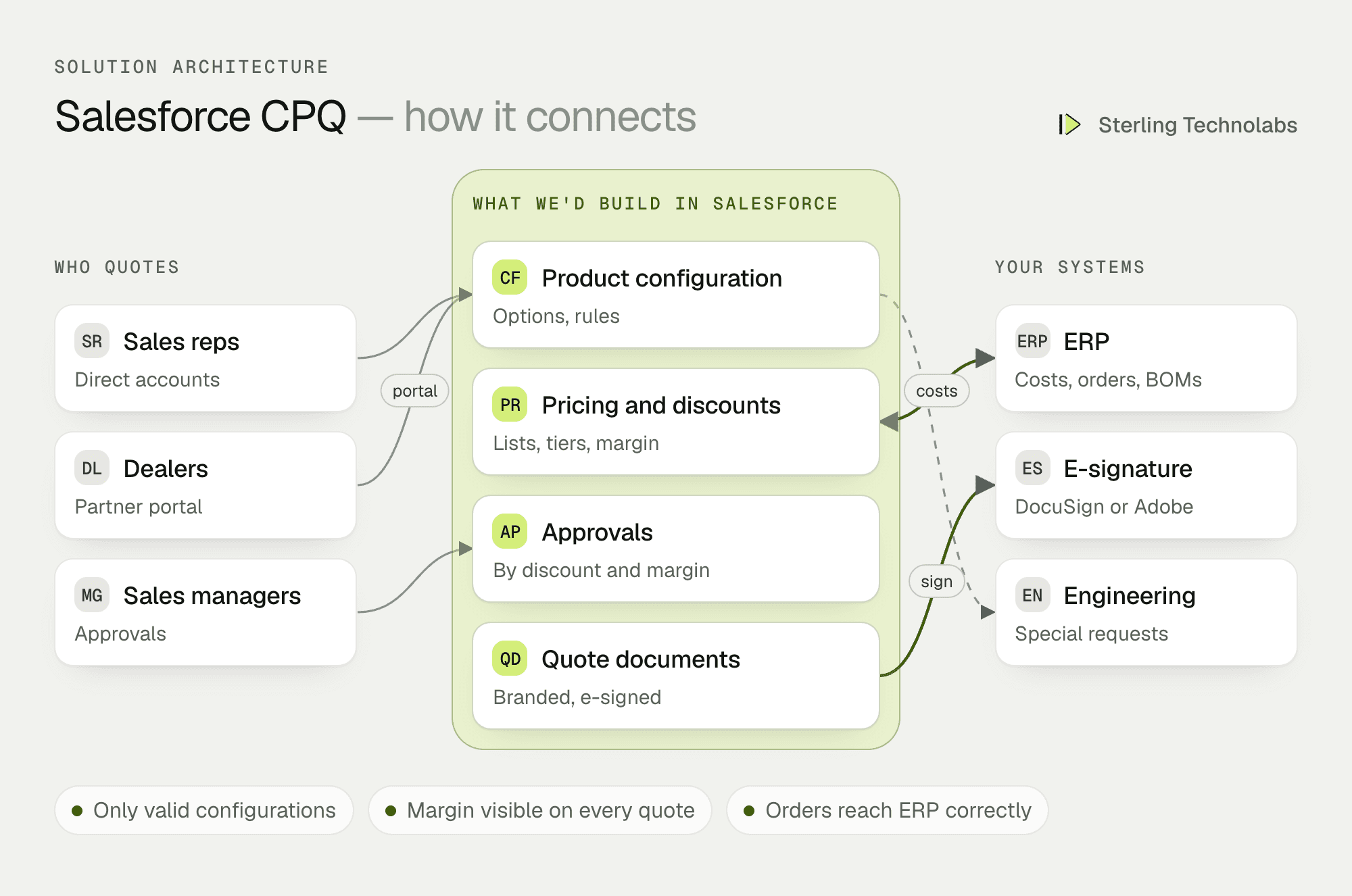
How the pieces fit
Which Salesforce quoting product
Salesforce CPQ has been the standard quoting product on Salesforce for years, and many companies already hold licences. For new projects Salesforce now also sells Revenue Cloud, its newer product for quoting and order management. The design here works with either: the work is the same, getting your product rules, pricing and approvals right. We'd confirm on the first call which product fits your licences and plans.
Rules from the people who know the machines
The hardest part of any CPQ implementation is getting product knowledge out of spreadsheets and people's heads. We'd run workshops with sales engineering and product management to write down every option, dependency and exclusion, then test the rules against a year of past quotes and orders. Unusual requests become an engineering review step, not a broken quote.
Margin before the quote goes out
Standard costs come from the ERP, so reps and managers see margin on every line before sending. Approval rules use discount and margin together: a large discount on a high-margin service plan may need no approval, while a smaller discount on a low-margin machine does. Every approval is recorded with its reason.
Clean orders into the ERP
When a customer signs, the quote becomes an order in Salesforce and goes to the ERP with every configured option, so the ERP can build the right bill of materials. Order status, ship dates and invoices come back into Salesforce for the rep.
One machine quote, end to end
Here is a case packer quoted for a food producer.
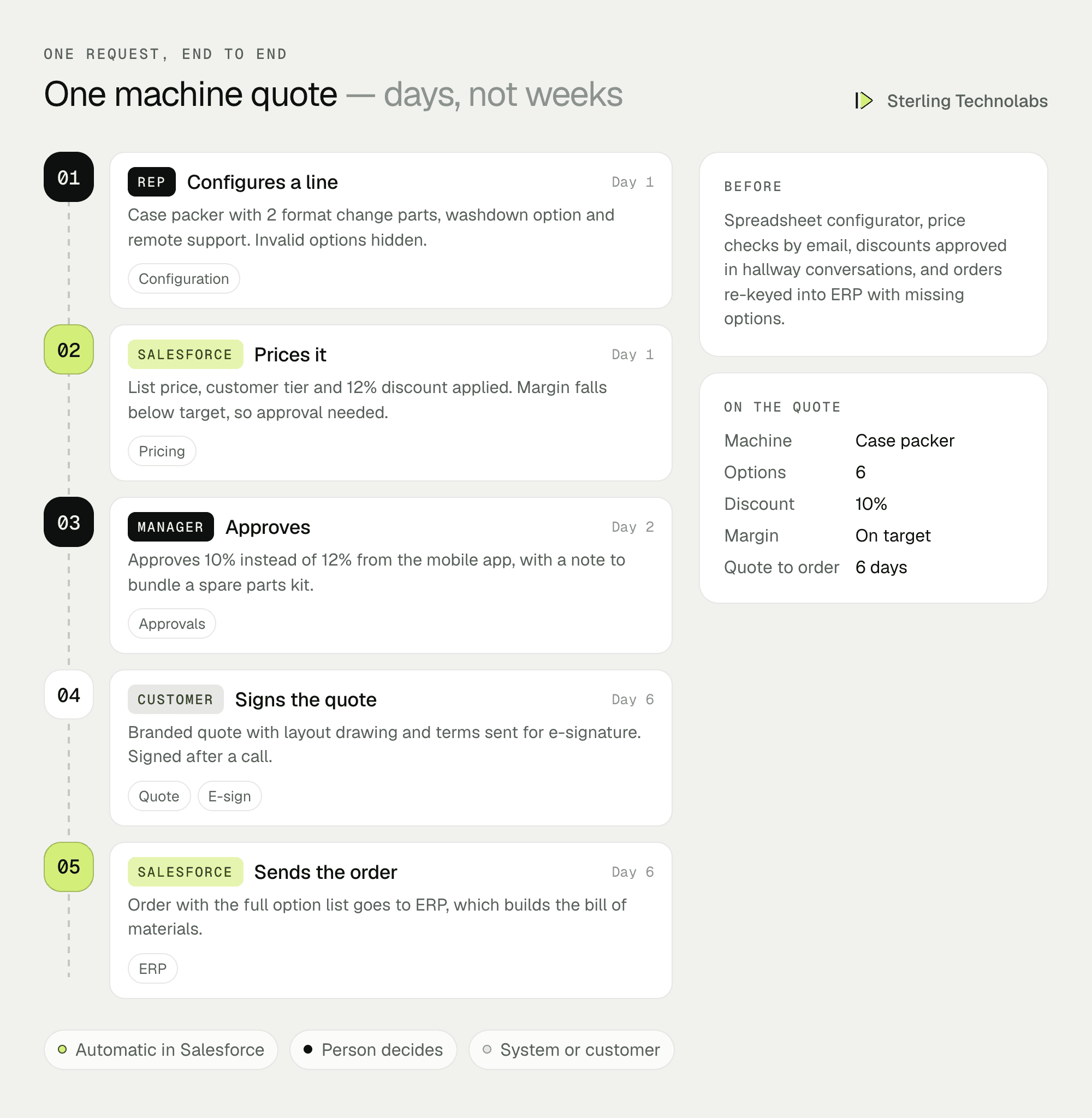
The quote contained only buildable options, the discount decision was recorded, and the ERP received an order it could build without phone calls.
What sales reps would see

Reps see each quote line with list and net price, overall margin, lead time and approval status. Selecting an option shows the rules attached to it.
Salesforce CPQ features by role
| Sales reps and dealers | Sales managers | Operations and finance |
|---|---|---|
| Guided configuration | Approvals from the phone | Clean orders into ERP |
| Prices by tier and currency | Margin on every quote | Standard costs from ERP |
| Branded quotes and e-signature | Discount history by rep | Lead times on quotes |
| Quote versions and renewals | Win rates by product | Service plan renewals |
Data and integrations
| Data | System of record | Direction | When |
|---|---|---|---|
| Products, options, rules, prices | Salesforce | Salesforce only | Not applicable |
| Standard costs and lead times | ERP | To Salesforce | Nightly |
| Signed orders | Salesforce, then ERP | Salesforce to ERP | On signature |
| Order status, ship dates, invoices | ERP | To Salesforce | Hourly |
| Signatures | DocuSign or Adobe Sign | Both ways | As quotes are sent and signed |
| Exchange rates | Finance | To Salesforce | Monthly |
Delivery plan
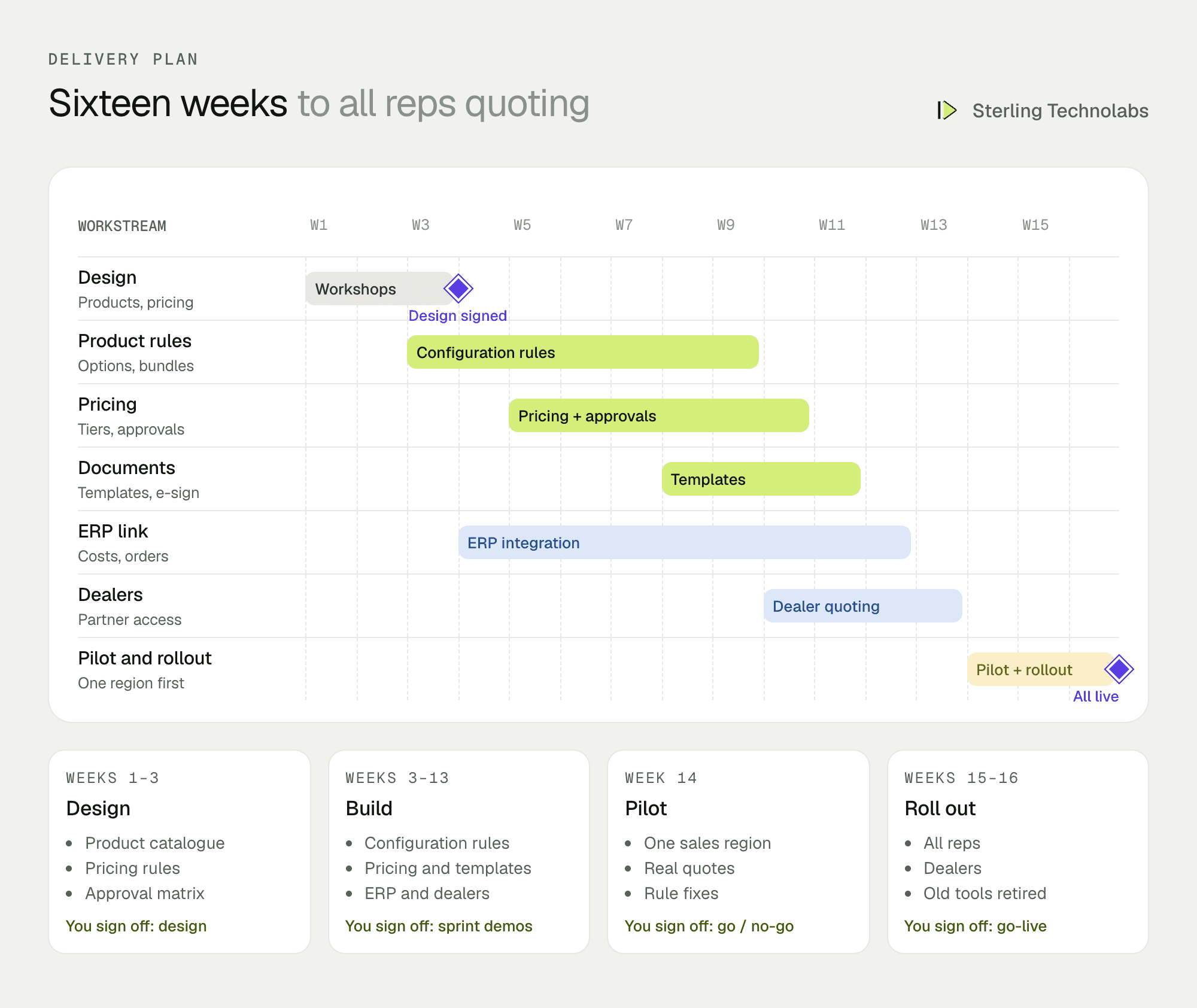
We'd pilot with one sales region on real deals for two weeks, fix the rules that real quotes expose, then roll out to all reps and the dealer network. The spreadsheet configurator is retired at go-live.
The team
| Role | Time | What they own |
|---|---|---|
| Salesforce solution architect | Part time | CPQ design, data model, integrations |
| CPQ business analyst | Full time | Product rules, pricing, approval matrix, UAT |
| Salesforce CPQ developers (2) | Full time | Configuration rules, pricing, templates, partner portal |
| Integration developer | Weeks 4–12 | ERP costs, orders and status |
| QA engineer | Weeks 7–16 | Rule tests against past quotes, UAT support |
From your side: a sales engineer, a product manager, a sales operations lead, two reps for testing, and your ERP administrator.
What changes the effort
- Product rules. The number of products, options and exceptions drives most of the effort.
- Pricing complexity. Tiers, contract prices, currencies and promotions each add work.
- Quote documents. Simple templates are quick; drawings and per-product sections take longer.
- ERP. A modern API is quicker than file transfers.
- Dealers. Partner quoting adds portal setup, dealer pricing and training.
Risks and how we'd handle them
| Risk | What we'd do |
|---|---|
| Rules incomplete or wrong | Rules tested against a year of past quotes, and an engineering review step for unusual requests. |
| Reps find it slower than spreadsheets | Guided selling for common machines, and reps testing screens from week 6. |
| Prices out of date | One owner for price books, with changes scheduled and logged. |
| Orders fail in ERP | Order validation before sending, with errors returned to the rep. |
| Too many approvals | Approval rules tuned on past deals so routine quotes don't wait. |
What we'd measure
| Metric | How we'd measure it | Baseline from |
|---|---|---|
| Quote turnaround | Days from request to quote sent | Sales team estimates and email |
| Quote errors | Orders changed after signing | ERP change orders |
| Average discount | Discount by product and rep | Past orders |
| Margin on won deals | Quoted margin against target | Finance reports |
| Approval time | Hours from request to decision | Not tracked today |
Build or buy?
For companies with simple price lists, Sales Cloud's standard quotes may be enough, and we'd tell you so. Salesforce CPQ or Revenue Cloud makes sense when you sell configured products with rules, tiered pricing and approvals, and want quoting inside the CRM your sales team already uses. A custom-built configurator only makes sense for very unusual products, and even then it usually sits beside Salesforce rather than replacing it.
Questions we'd ask on the first call
- How many products and options do you sell, and where do the rules live today?
- How long does a typical quote take, and what goes wrong?
- How are discounts approved?
- Which ERP do you use, and how do orders get there?
- Do you hold Salesforce CPQ licences already?
FAQ
What is Salesforce CPQ?
It is Salesforce's configure, price, quote product: it guides reps through valid product configurations, applies pricing and discounts, routes approvals and produces quote documents inside Salesforce.
Should we use Salesforce CPQ or Revenue Cloud?
It depends on your licences and plans. Many companies extend existing CPQ; new projects often start on Revenue Cloud. The product rules, pricing and approvals work is similar either way.
Does a Salesforce CPQ consultant need to know our products?
They need to learn them quickly. A good CPQ business analyst runs workshops with your sales engineers and tests the rules against your past quotes.
How long does a Salesforce CPQ implementation take?
For a manufacturer with configured machines, ERP integration and dealer quoting, typically 14 to 16 weeks.
:: Typical stack
Salesforce CPQ or Revenue Cloud, Sales Cloud, Experience Cloud partner portal, Flow, ERP integration, DocuSign or Adobe Sign
:: Related service
Salesforce Sales Cloud
See the service

Send us your brief. We’ll help turn it into reality
A senior engineer replies within one business day with questions or a first plan: approach, team, timeline and estimate.
More blueprints like this


