Salesforce Health Cloud implementation for a multi-specialty hospital group
In many hospital groups, patient information is split across the hospital information system, call-centre notes and WhatsApp threads. This is how we'd implement Health Cloud to give care coordinators one view of each patient and keep follow-ups from slipping.
Industry
Healthcare
Typical timeline
16–20 weeks
Typical team
6 people

The situation
Picture a multi-specialty hospital group with four hospitals and a dozen clinics across Pune, strong in cardiology, orthopaedics and oncology. Its hospital information system handles registrations, billing and clinical records well. Everything around the clinical record is scattered.
Referrals from local doctors arrive by phone, WhatsApp and email, and many are never tracked to an appointment. The call centre can't see whether a caller is an existing patient at another branch. After discharge, follow-up calls depend on a nurse's spreadsheet. Referring doctors rarely hear what happened to their patients, so they refer elsewhere next time. And marketing sends health-camp messages to people who never agreed to receive them.
The group doesn't need another clinical system. It needs one place to manage the patient relationship: who referred whom, what was promised, what follow-up is due and what the patient has agreed to receive, connected to the HIS so nobody types visits in twice.
Signs this blueprint fits you
- Referrals come in through several channels and you can't say how many converted to visits.
- Your call centre works from the HIS and spreadsheets, with no history of past conversations.
- Post-discharge follow-ups are inconsistent between departments and branches.
- You need to show patient consent for messages under the DPDP Act.
What we'd build
- Patient 360 in Health Cloud: one record per patient across branches, linked to the HIS by UHID, with appointments, referrals, tasks and communication history.
- Referral management, with a partner portal where referring doctors submit referrals and see their status.
- Care plans and follow-up tasks for common pathways, such as post-angioplasty or post-knee replacement, assigned to care coordinators.
- A coordinator console that brings the referral queue, patient timeline, tasks and consent onto one screen.
- WhatsApp messaging for confirmations, reminders and feedback, sent only where the patient has agreed.
- HIS integration through HL7 and FHIR, so registrations, appointments, visits and discharges appear in Health Cloud automatically.

How the pieces fit
A clear line between clinical and engagement data
Diagnoses, notes, prescriptions and results stay in the HIS. Health Cloud holds the relationship: who the patient is, how they reached you, which appointments and tasks exist, and what they have consented to. This keeps clinical governance where it is and limits the sensitive data held in a second system.
Integration with the HIS
Most Indian HIS products can send HL7 v2 messages for admissions, discharges and transfers, and some support FHIR. An integration engine receives these events and updates Health Cloud: a new registration creates or matches a patient, a discharge triggers the right care plan, a completed visit updates the referral. Where the HIS can only export files, we schedule those instead.
Referrals and the partner portal
Referring doctors get a simple Experience Cloud portal: submit a referral with notes and attachments, then see whether the patient was contacted, booked and seen. Reports are shared only when the patient has consented. That feedback loop is what brings doctors back.
Consent
Every patient record carries consent by channel and purpose: appointment messages, follow-up calls, health-camp invitations. Messaging checks consent before sending, and changes are kept as an audit trail.
One referral, end to end
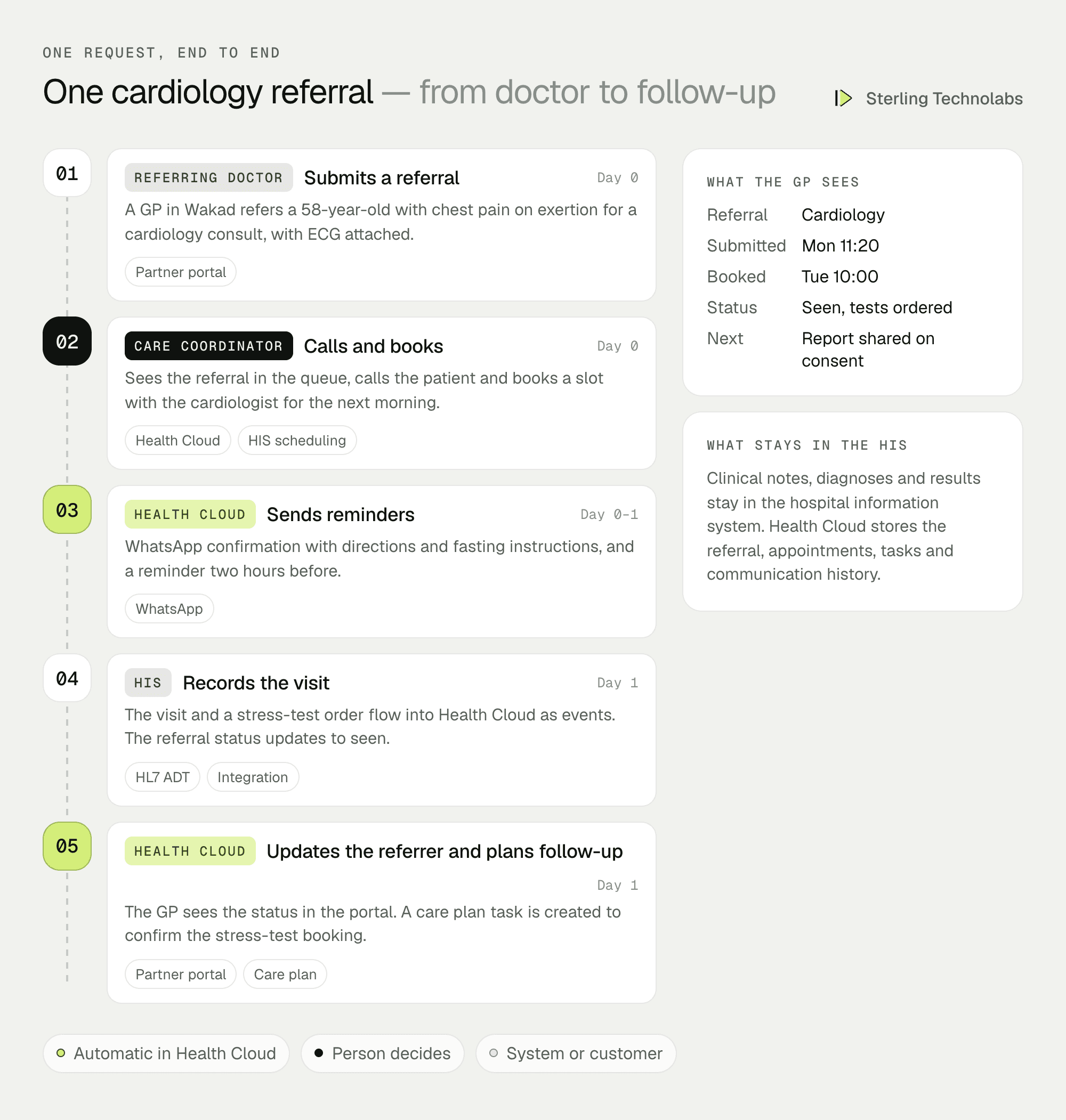
Here is a cardiology referral from a local GP, traced from submission to follow-up.
What care coordinators would see
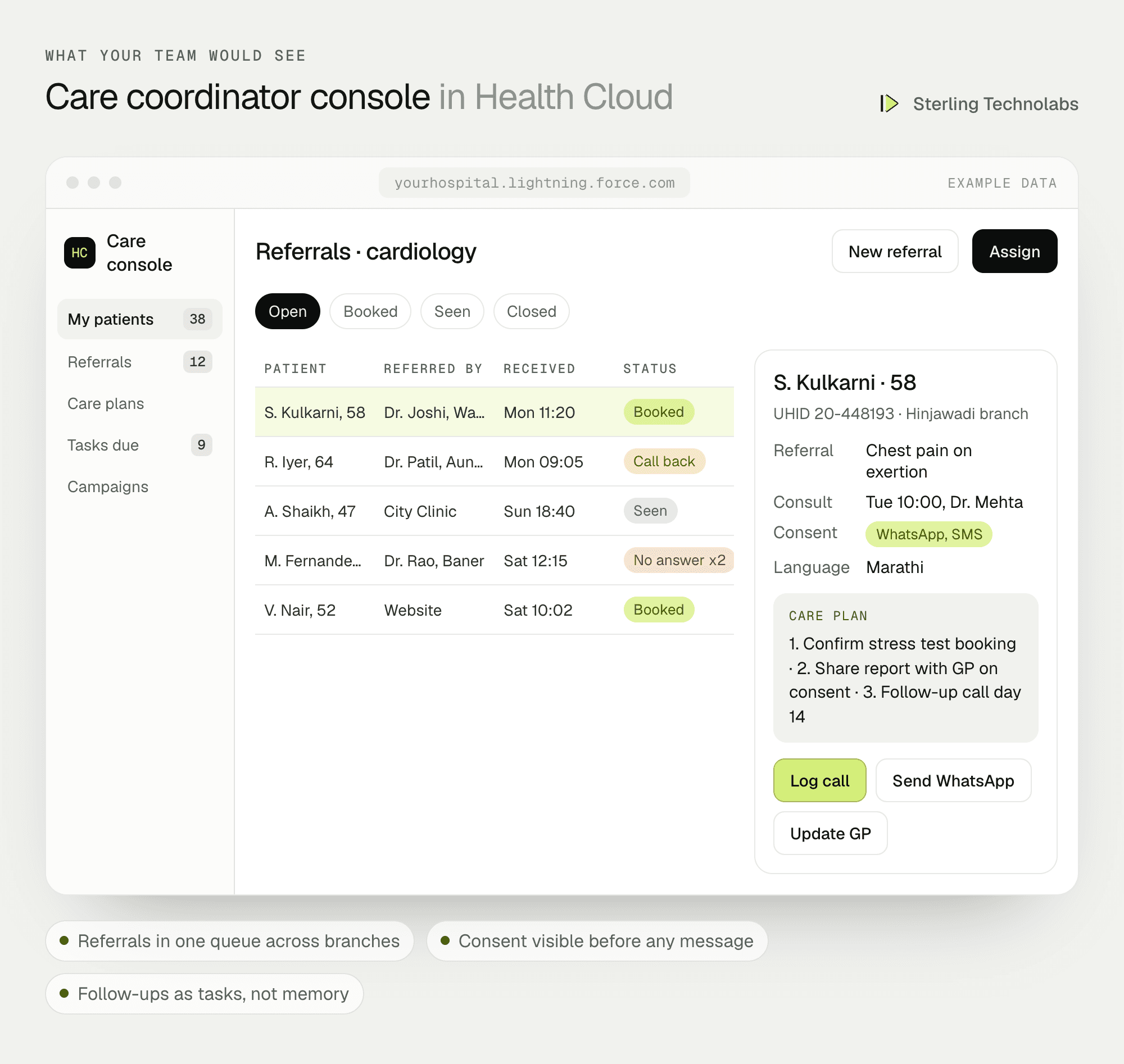
Care coordinators work from one console: a queue of referrals and tasks, the patient's timeline across branches, the care plan and the consent status. They no longer need the HIS, a spreadsheet and WhatsApp open at the same time.
Data and integrations
| System | What flows | Direction | How we connect |
|---|---|---|---|
| Hospital information system | Registrations, appointments, admissions, discharges | HIS to Salesforce | HL7 v2 ADT or FHIR via integration engine |
| HIS scheduling | Slot availability and bookings | Both ways, where supported | HIS API or booking screen link |
| WhatsApp Business | Confirmations, reminders, replies | Both ways | Approved BSP connected to Salesforce |
| Partner portal | Referrals, status, consented reports | Both ways | Experience Cloud |
| Marketing Cloud (optional) | Health camps, check-up reminders | Salesforce to Marketing Cloud | Standard connector, consent filtered |
Delivery plan
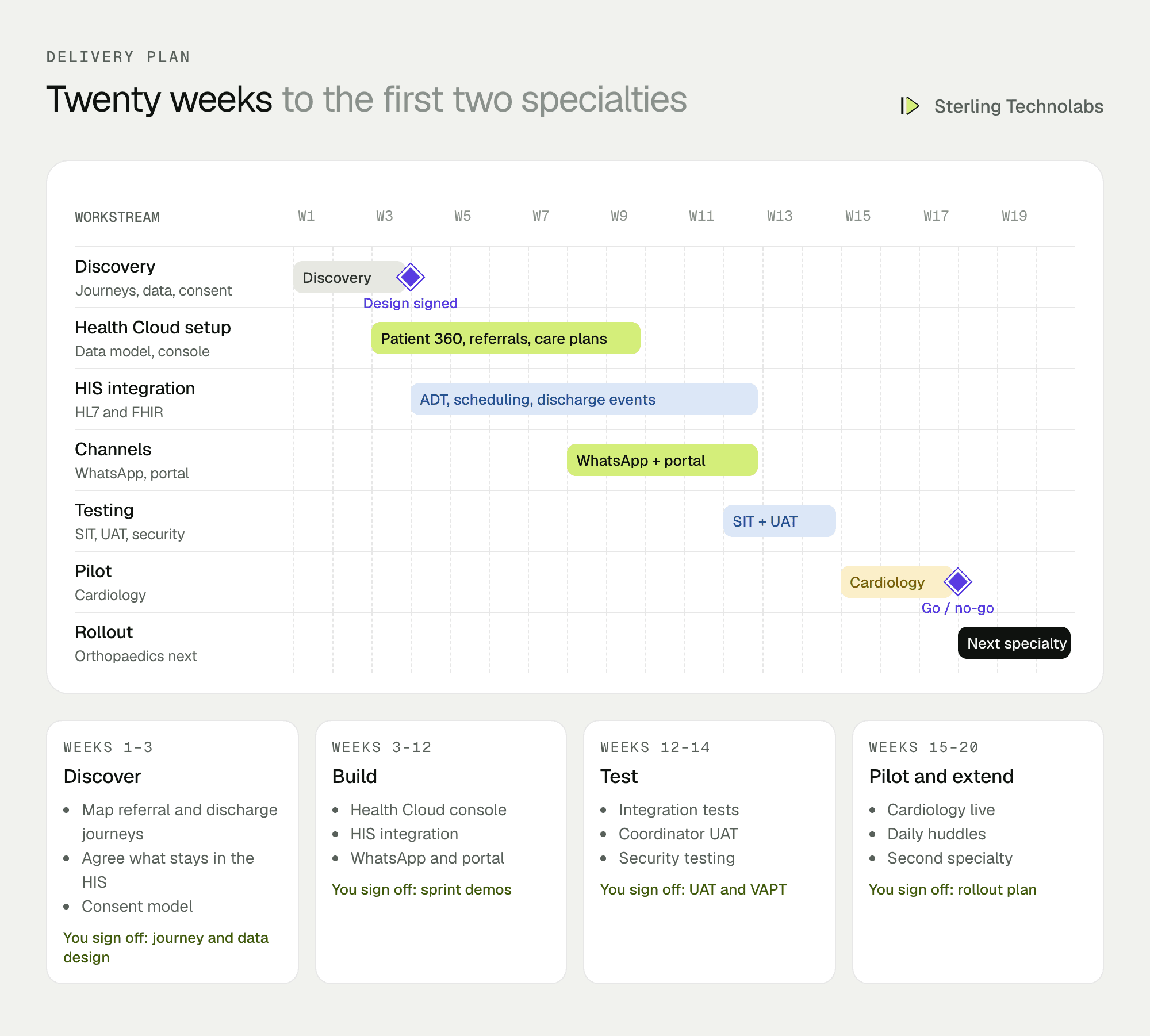
We'd pilot in one specialty, cardiology in this example, because referral volume is high and follow-up pathways are well defined. Coordinators hold a short daily huddle during the pilot to raise problems. The second specialty reuses the same building blocks with its own care plans.
The team
| Role | Time | What they own |
|---|---|---|
| Salesforce solution architect | Part time | Health Cloud data model, security, integration design |
| Business analyst | Weeks 1–14 | Journey mapping with clinical and front-office teams |
| Salesforce developers (2) | Full time | Console, care plans, referrals, portal, flows |
| Integration developer | Weeks 4–14 | HL7/FHIR interfaces, patient matching, monitoring |
| QA engineer | Weeks 10–17 | Integration tests, UAT support, security test fixes |
From your side: a head of patient services, a clinical lead per pilot specialty, the HIS vendor for interface work, and your information security team.
What changes the effort
- HIS interface capability. A HIS with HL7 or FHIR is much quicker than one that only exports files.
- Patient matching. Duplicate records across branches need a matching approach agreed with medical records.
- Number of care pathways. Each pathway needs its own tasks, timings and messages.
- Telephony. Click-to-call and call logging from your contact-centre platform add a separate integration.
- Marketing scope. Health camps and campaigns in Marketing Cloud are a separate phase.
Risks and how we'd handle them
| Risk | What we'd do |
|---|---|
| Sensitive data in a second system | Keep clinical data in the HIS, apply field-level security and Shield encryption where needed, and run a security test before go-live. |
| Duplicate or mismatched patients | Match on UHID first, then on agreed rules, with a merge queue for medical records to review. |
| Messages without consent | Consent checked in the flow before every send, with a full audit trail. |
| Coordinators stay in spreadsheets | Involve them in design, pilot in one specialty, and retire the spreadsheet on a fixed date. |
| HIS vendor delays | Agree interface specs in week two and keep a file-based fallback ready. |
What we'd measure
| Metric | How we'd measure it | Baseline from |
|---|---|---|
| Referral to appointment | Share of referrals booked within 48 hours | Manual sample before go-live |
| Referrer feedback loop | Share of referrals where the doctor saw a status update | Not tracked today |
| Follow-up completion | Care plan tasks done on time, per pathway | Current nurse spreadsheets |
| No-show rate | Missed appointments for patients who got reminders | HIS appointment data |
| Repeat referrers | Doctors who refer again within 90 days | HIS referral source field |
Build or buy?
Some HIS vendors offer CRM modules, and if yours covers referrals and follow-ups well, extending it may be enough. Health Cloud makes sense when you want a proper relationship layer across many branches and channels, a partner portal for referring doctors, and room to add marketing, contact-centre and analytics later on the same platform. It's not a replacement for the HIS, and we'd advise against using it as one.
Questions we'd ask on the first call
- Which HIS do you use, and does it support HL7 or FHIR?
- How do referrals reach you today, and who handles them?
- Which specialty has the clearest follow-up pathway to start with?
- How is patient consent captured and stored now?
- Do you already use Salesforce anywhere in the group?
FAQ
Does Health Cloud replace our HIS?
No. The HIS stays the clinical record. Health Cloud manages referrals, follow-ups, communication and consent around it.
Where is patient data stored?
Salesforce offers data residency options, including India-based infrastructure for some products. We'd confirm the right setup for your contract and security review during discovery.
Can doctors use it?
Referring doctors use the partner portal. Your own clinicians usually stay in the HIS, with care coordinators as the main Health Cloud users.
:: Typical stack
Salesforce Health Cloud, Experience Cloud, Marketing Cloud, Flow, HIS integration via HL7 FHIR APIs
:: Related service
Salesforce Health Cloud
See the service

Send us your brief. We’ll help turn it into reality
A senior engineer replies within one business day with questions or a first plan: approach, team, timeline and estimate.
More blueprints like this


