Warehouse management system for a 3PL
3PLs running on single-company warehouse software lose time to spreadsheets and miss billable work. This is how we'd build a multi-client WMS with scanning at every step, direct store connections, a client portal and billing from the work itself.
Industry
Third-party logistics
Typical timeline
18–22 weeks
Typical team
7 people

The situation
Picture a third-party logistics provider (3PL) in Reno, Nevada, with two warehouses totalling 600,000 square feet. It stores and ships for about 60 ecommerce and wholesale brands: apparel, skincare, supplements, pet food and home goods. On a normal day it ships 9,000 orders; in November and December, three times that.
Its warehouse management system was bought ten years ago for a single-company warehouse and stretched to fit. Client orders are imported by spreadsheet twice a day. Pick lists are printed. Some clients need lot and expiry tracking, others need kitting or retail labels, and each of those is handled by a workaround someone remembers. Brands email to ask about stock and order status. At month-end, the finance team spends a week building client bills from exports, and the 3PL knows it misses billable work.
The 3PL wants custom warehouse management system development: a WMS built for many clients, with scanning at every step, direct connections to clients' stores, a client portal and billing based on actual activity.
Signs this blueprint fits you
- You run warehouses for many clients, each with their own rules.
- Orders arrive by spreadsheet or email instead of direct connections.
- Picking and receiving use paper lists.
- Clients ask by email for stock levels and order status.
- Billing is built by hand and you suspect you miss billable work.
What we'd build
- Multi-client inventory: each client's stock kept separate by item, location, lot, expiry and serial number where needed, across both buildings.
- Receiving and putaway against advance shipping notices, with scans, damage photos and directed putaway to the right locations.
- Picking, packing and shipping: waves by client and carrier cut-off, scan-to-pick on handhelds, box selection, and rate shopping across carriers when labels print.
- Client rules: lot and expiry picking, kitting, gift messages, retail labels and B2B routing guides, set per client without code changes.
- Direct client connections to Shopify, Amazon, other marketplaces and EDI for orders and stock levels.
- A client portal with live stock, orders, receipts, returns and invoices.
- Activity-based billing: storage, receiving, picks, packaging and special projects priced by each client's rate card, and invoices sent to accounting.
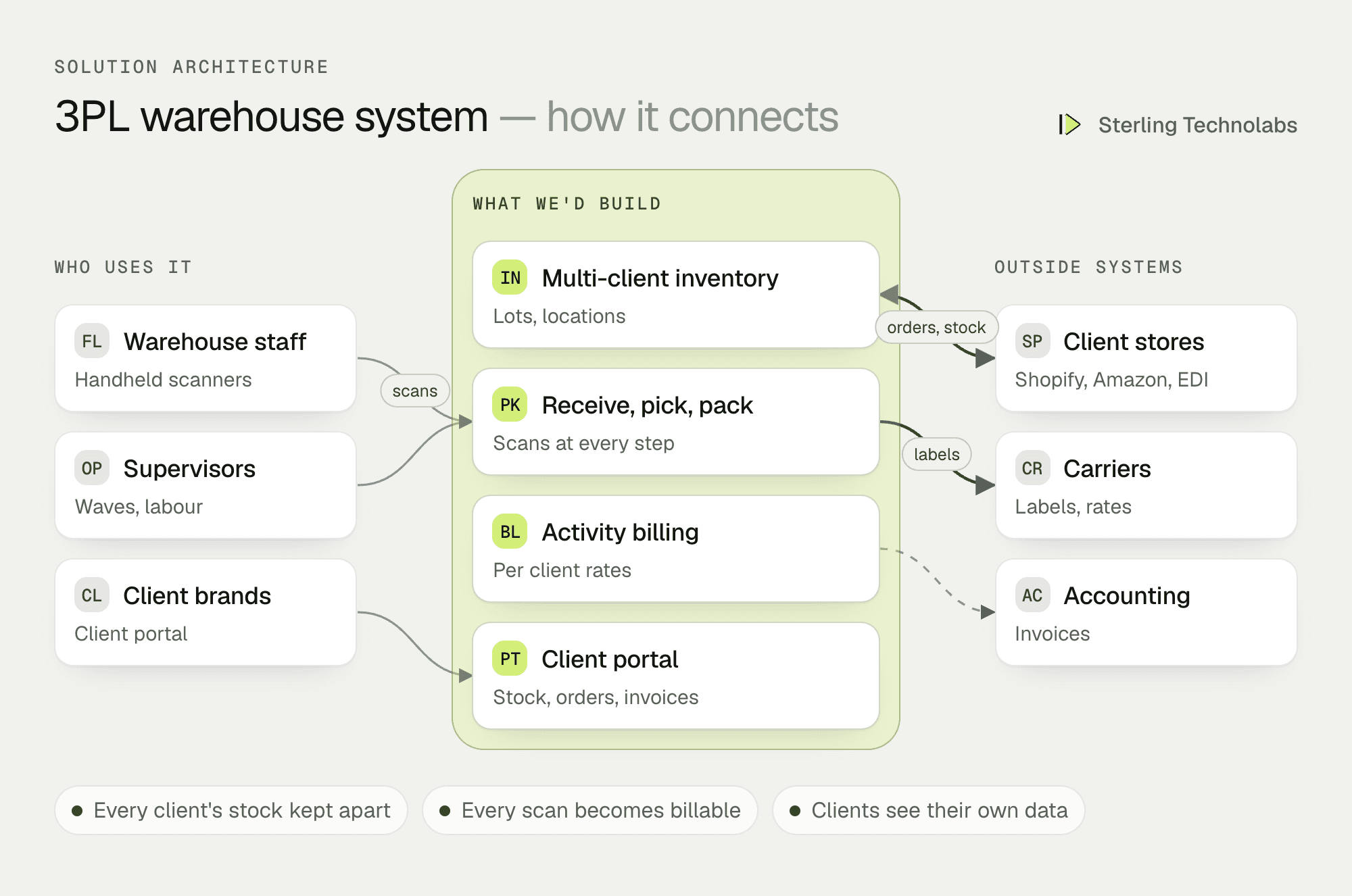
How the pieces fit
Built for many clients from the start
A 3PL warehouse management system is different from one for a single company. Every item, location movement and order belongs to a client, every rule can vary by client, and clients must only ever see their own data. That client layer is in the data model from day one, not added later.
Scans everywhere, paper nowhere
Every movement is a scan: receiving, putaway, replenishment, picking, packing and cycle counts. That keeps inventory accurate across 60 clients, and every scan is a record of work done, which is what billing needs. The handheld app tells staff where to go next and works on rugged Android scanners.
Waves that meet cut-offs
Supervisors see orders by client, service level and carrier cut-off. The WMS suggests waves so same-day orders and B2B shipments with fixed pickup times go first, and flags shortages before picking starts instead of at the pick face. When a short happens, the client's rules decide whether to hold, split or substitute.
Billing from the work itself
Each client has a rate card: storage by pallet or bin, fees per receipt, order, pick and box, and project rates. The WMS records every billable activity as it happens and builds invoices at month-end for finance to review and send through accounting. Clients see the same detail in the portal, which ends most billing disputes.
One order, end to end
Here is an order from a skincare brand's Shopify store with lot-tracked items.
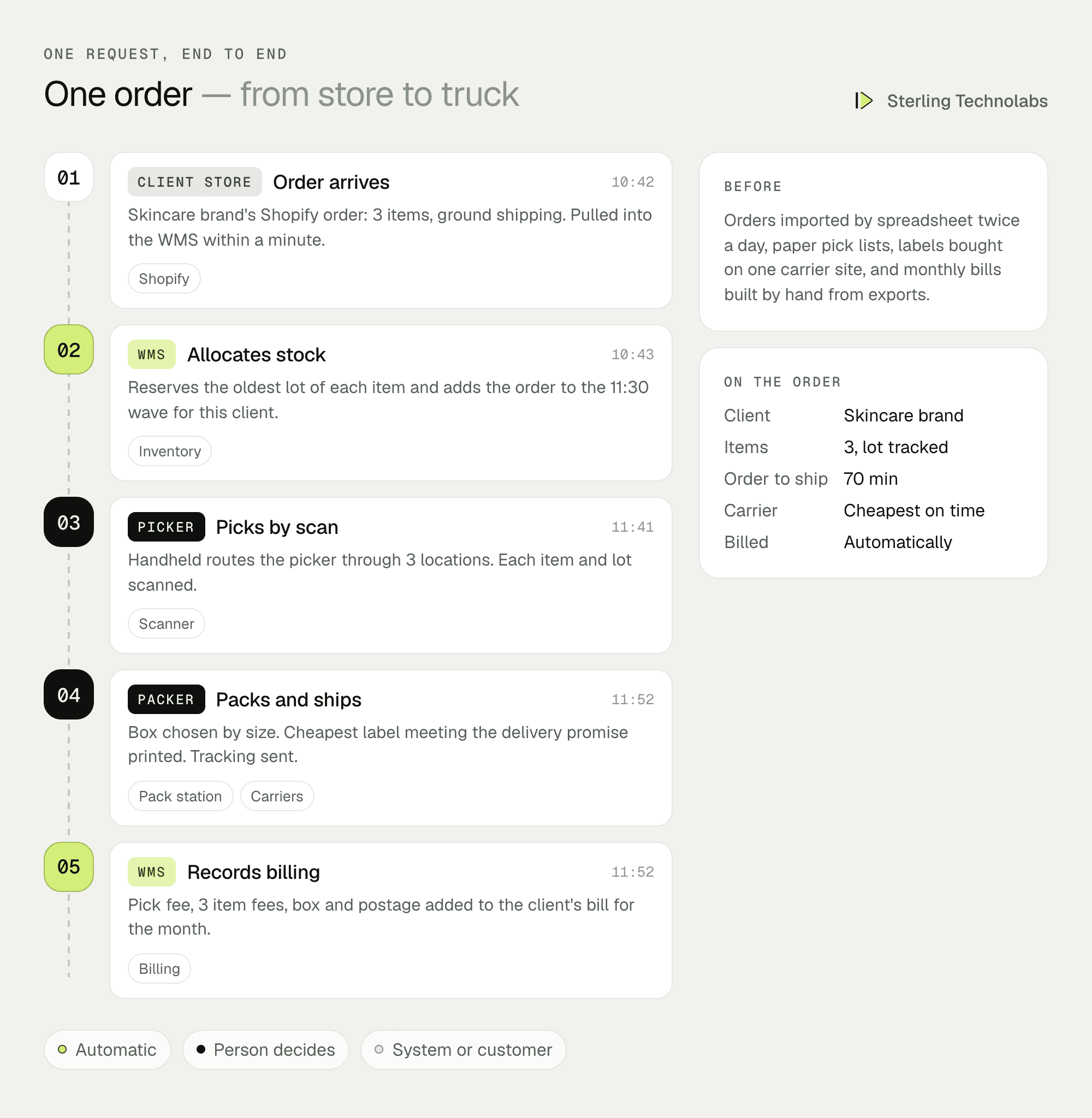
The order shipped 70 minutes after it was placed, the oldest stock went out first, and every billable step was recorded without anyone typing it.
What supervisors would see

Supervisors see waves by client and cut-off, progress, labour and exceptions such as short picks. Clients see their own stock and orders in the portal.
WMS features by user
| Warehouse staff | Supervisors and managers | Client brands |
|---|---|---|
| Scan-to-pick on handhelds | Waves by client and cut-off | Live stock and orders |
| Directed putaway | Shortages before picking | Receipts and returns |
| Box and label at pack | Labour by task | Invoices with detail |
| Cycle counts | Billing by client | Reports to download |
Data and integrations
| Integration | What it's for | Example options |
|---|---|---|
| Ecommerce stores | Orders in, stock and tracking out | Shopify, BigCommerce, WooCommerce |
| Marketplaces | Orders and inventory | Amazon, Walmart, TikTok Shop |
| EDI | Retail and wholesale orders, ASNs | An EDI provider |
| Carriers | Rates, labels, tracking | UPS, FedEx, USPS, regional carriers |
| Accounting | Client invoices and payments | QuickBooks, NetSuite or Xero |
| Scanners and printers | Handhelds and label printers | Rugged Android scanners, Zebra printers |
Delivery plan
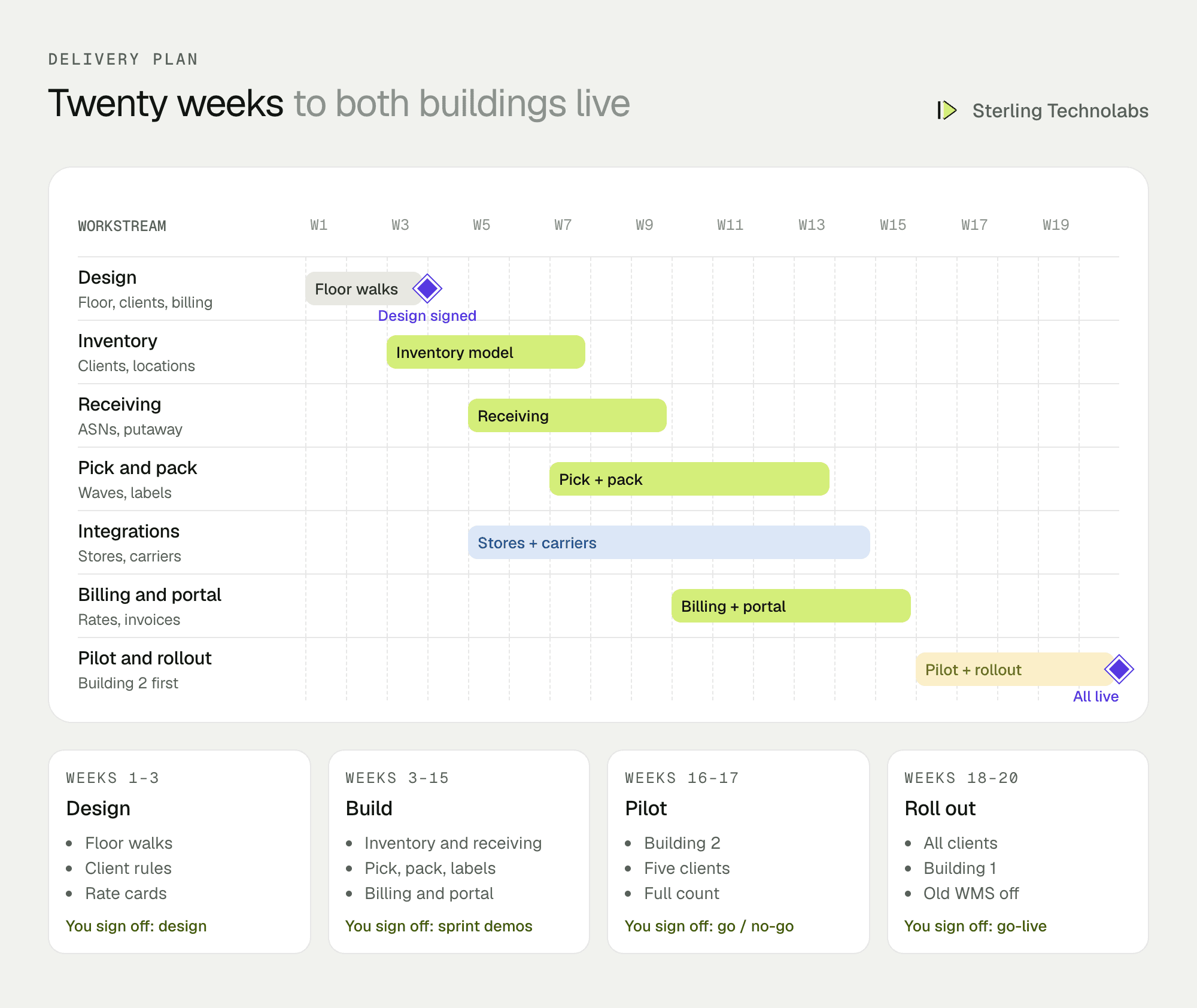
We'd pilot in one building with five clients chosen to cover the main rules: lot tracking, kitting, B2B and high-volume ecommerce. After a full inventory count and two weeks of live running, the remaining clients move over, then the second building. Peak season is never the time to switch, so go-live is planned for the first half of the year.
The team
| Role | Time | What they own |
|---|---|---|
| Solution architect | Part time | Architecture, multi-client data model, performance |
| Business analyst with 3PL experience | Full time | Floor processes, client rules, billing, UAT |
| Back-end developers (2) | Full time | Inventory, waves, billing, integrations |
| Mobile developer | Full time | Handheld scanner app |
| Front-end developer | From week 5 | Supervisor screens, client portal |
| QA engineer | From week 6 | Scanner tests, load tests, pilot support |
From your side: an operations manager, a supervisor from each building, an account manager who knows client rules, and your finance lead for billing.
What changes the effort
- Client rules. Lot tracking, kitting, retail compliance and returns each add work.
- Integrations. Each store platform, marketplace and EDI partner adds a connector.
- Automation. Conveyors, sorters and print-and-apply machines need equipment integration.
- Billing complexity. Simple rate cards are quick; tiered and minimum charges take longer.
- Buildings. Each site adds a go-live count and training.
Risks and how we'd handle them
| Risk | What we'd do |
|---|---|
| Wrong stock at go-live | Full count per client before cutover, with clients signing off their numbers. |
| Missed carrier cut-offs | Waves planned around cut-offs, and load tests at three times normal volume. |
| Client data seen by another client | Client separation in the data model, tested at every release. |
| Disruption in peak season | Go-live in the first half of the year, one building at a time. |
| Billing disputes | Activity detail in the portal and a first month of side-by-side billing. |
What we'd measure
| Metric | How we'd measure it | Baseline from |
|---|---|---|
| Orders shipped on time | Orders shipped by their cut-off | Current WMS reports |
| Inventory accuracy | Cycle count matches by location | Last full count |
| Picks per hour | Units picked per labour hour | Labour reports |
| Billing time | Days to issue month-end invoices | Finance team |
| Billable activity captured | Billed activities against recorded scans | Pilot comparison |
Build or buy?
3PL warehouse management systems are available off the shelf, and for many providers one of them is the right answer. Custom warehouse management software development makes sense when your client mix needs rules the products don't handle well, when billing and client experience are how you win business, or when per-order fees cut into thin margins. Some 3PLs keep a product WMS and build a custom client portal and billing layer around it.
Questions we'd ask on the first call
- How many clients, buildings and orders a day, and what does peak look like?
- Which client rules cause the most work today?
- How do orders reach you, and which platforms do clients sell on?
- How do you bill clients now, and what do you think you miss?
- Do you use conveyors, sorters or other automation?
FAQ
What is a 3PL warehouse management system?
A WMS built for warehouses that store and ship for many clients, with client-separated inventory, per-client rules, client portals and billing based on activity.
How long does warehouse management system development take?
For a 3PL with two buildings, integrations, a client portal and billing, a first release typically takes 18 to 22 weeks.
Can a custom WMS connect to Shopify and Amazon?
Yes. Orders come in and stock levels and tracking go out through each platform's API, so clients don't send spreadsheets.
Does a custom WMS work with our scanners and printers?
Usually. The handheld app runs on rugged Android scanners, and labels print to standard thermal printers such as Zebra.
:: Typical stack
React, Node.js, PostgreSQL, Android scanner app, Shopify and Amazon APIs, EDI, carrier APIs, NetSuite or QuickBooks
:: Related service
Custom software development
See the service

Send us your brief. We’ll help turn it into reality
A senior engineer replies within one business day with questions or a first plan: approach, team, timeline and estimate.
More blueprints like this


