Ordering and loyalty app for a restaurant chain
Aggregator apps own the restaurant's customers and take a large commission on every order. This is how we'd build a branded app for ordering and loyalty that brings regulars back to direct orders and shows the chain who its best customers are.
Industry
Restaurants and QSR
Typical timeline
14–16 weeks
Typical team
5 people

The situation
Picture a restaurant chain with 28 outlets across Pune, Mumbai and Bengaluru: a casual-dining biryani and kebab brand with strong dine-in and a growing share of delivery. Most delivery and many pickup orders come through aggregator apps.
The aggregators bring volume, but the chain pays a large commission on every order and learns almost nothing about its customers. It can't tell who its regulars are, can't reward them, and can't reach them when a new outlet opens. A paper stamp card exists at a few outlets, but nobody knows whether it works. The marketing team runs Instagram campaigns without knowing whether they bring anyone back.
The chain needs its own app: easy enough that regulars prefer it for pickup and delivery, with loyalty that also works for dine-in, and enough data to send the right offer to the right person instead of discounts to everyone.
Signs this blueprint fits you
- A large share of orders comes through aggregators, and the commission hurts margins.
- You have loyal regulars but no way to recognise or reward them.
- Offers go to everyone, and you can't tell which ones work.
- Your POS can accept online orders through an API or partner integration.
What we'd build
- A branded app for iOS and Android, built in Flutter: browse the menu by outlet, order for pickup or delivery, pay, track and reorder in two taps.
- A loyalty engine with points, tiers and rewards that work for app orders and dine-in, by scanning a QR code on the bill.
- Segments and offers based on real behaviour: regulars, lapsed customers, birthdays, people close to a reward.
- POS integration so app orders arrive in the kitchen as normal KOTs and menu items and stock-outs stay in sync.
- An admin console for marketing and operations: menus per outlet, offers, segments, push campaigns and reports.

How the pieces fit
The POS stays the centre of the outlet
Kitchens shouldn't need another screen. App orders go into the outlet's POS through its online-order integration, so they print and track exactly like counter or aggregator orders. Menu prices and stock-outs come from the POS, so the app never sells an item the outlet can't make.
Loyalty that covers dine-in
Most of a casual-dining chain's revenue is still dine-in. A QR code printed on the bill lets members claim points for table orders, which brings dine-in customers into the app and gives the chain one view of each regular.
Rewards that make economic sense
Before building, we model the cost of the loyalty programme with your finance team: earning rate, reward cost, expected redemption. The aim is rewards that feel close enough to motivate, without giving away margin to people who would have ordered anyway.
Offers from behaviour, not guesses
Segments are built from order history: who orders on Fridays, who hasn't ordered in 45 days, who is 50 points from a reward. Offers go to segments by push, WhatsApp or SMS, and each one is measured by redemption and the orders that follow.
One order, end to end
Here is a Friday pickup order from a regular, and the offer that brings them back the next week.
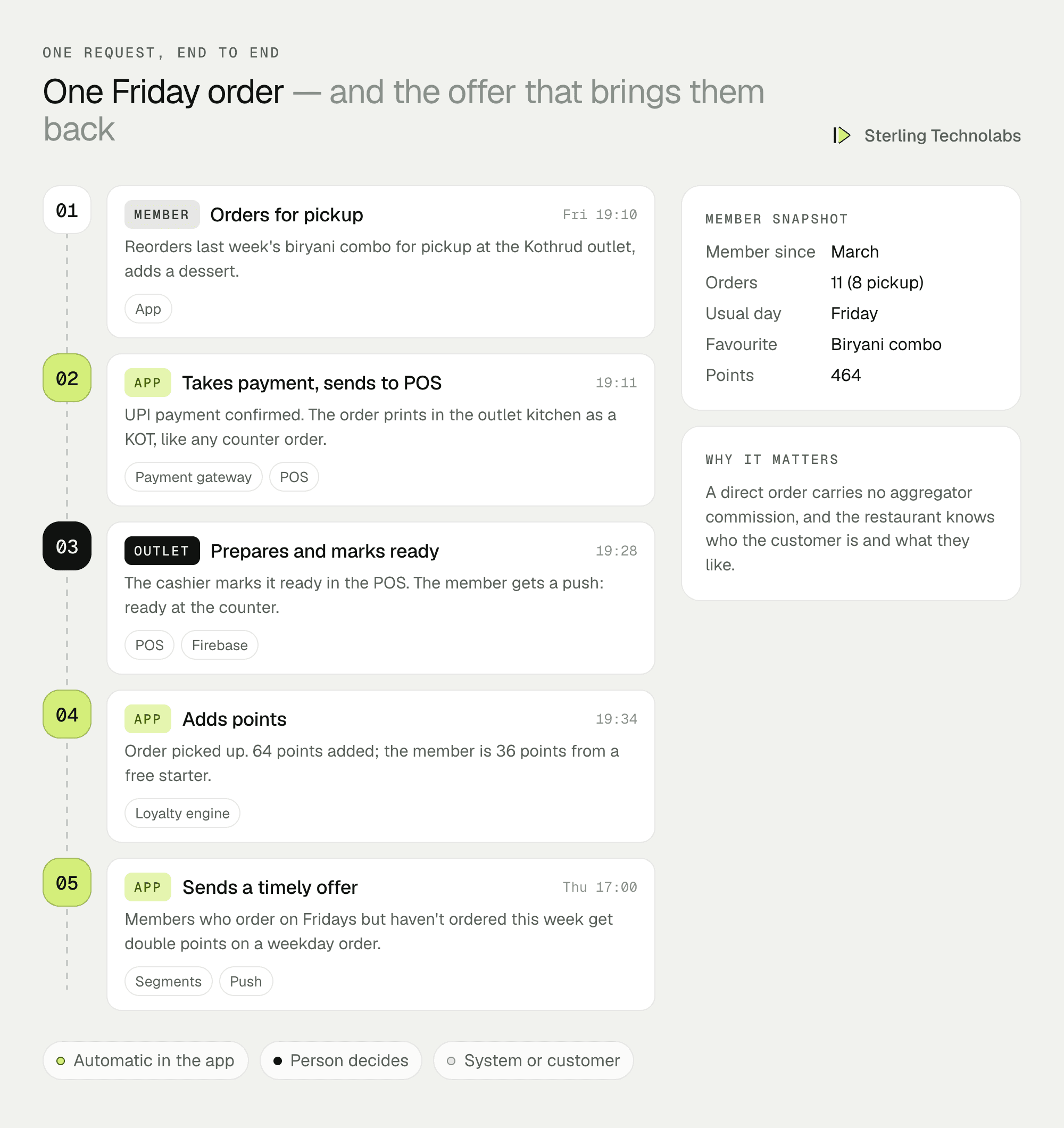
What marketing and members would see
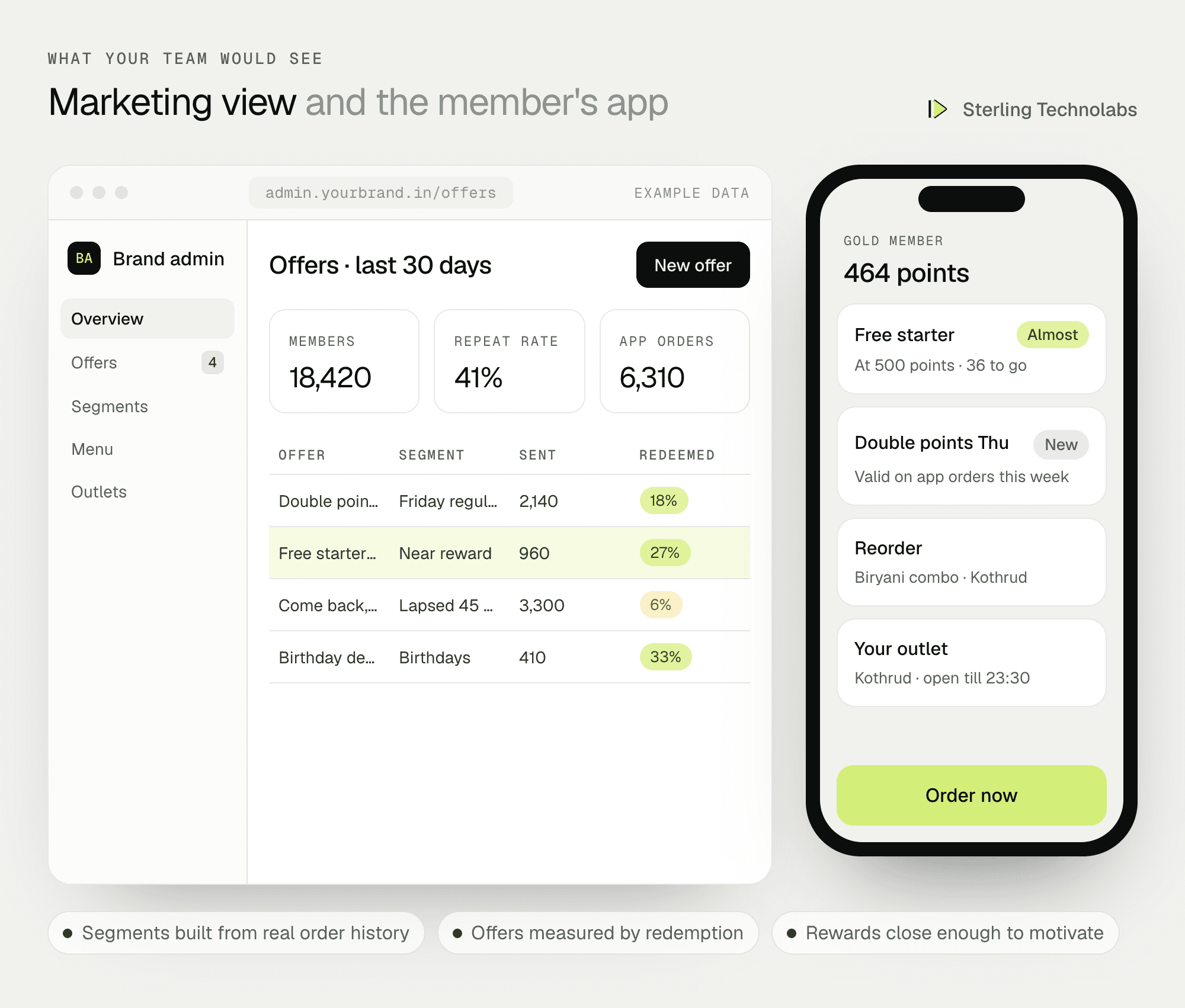
Marketing sees members, repeat rate and offer performance in one admin console. Members see their points, the next reward and offers that are relevant to them, with their usual order one tap away.
Data and integrations
| System | What flows | Direction | How we connect |
|---|---|---|---|
| POS (Petpooja, Posist, Rista or similar) | Menu, prices, stock-outs, orders, order status | Both ways | POS online-order API |
| Payment gateway (Razorpay, PayU) | UPI, card and wallet payments, refunds | Both ways | Gateway SDK and webhooks |
| Delivery partner | Rider assignment and tracking | Both ways | Own fleet app or 3PL API |
| Firebase | Push notifications, app analytics, crash reports | Outbound | Firebase SDK |
| WhatsApp and SMS | Order updates, offers to opted-in members | Outbound | BSP and SMS gateway |
Delivery plan

A two-week beta in three outlets, with staff and a few hundred invited regulars, catches the issues that only appear in a busy kitchen: a modifier that doesn't print, a stock-out that doesn't sync, a pickup flow that confuses the cashier. Store launch follows with an in-outlet sign-up push and a launch offer.
The team
| Role | Time | What they own |
|---|---|---|
| Product manager | Part time | Scope, loyalty rules, launch plan |
| Product designer | Weeks 1–8 | App and admin design, usability tests |
| Flutter engineers (2) | Weeks 5–14 | iOS and Android app |
| Backend engineer | Full time | API, loyalty engine, admin, integrations |
| QA engineer | Weeks 9–16 | Device testing, POS testing, beta support |
What changes the effort
- POS integration. A POS with a solid online-order API is quick. Several different POS systems across outlets add work.
- Delivery. Pickup only is simplest. Own-fleet delivery or third-party logistics adds tracking and dispatch.
- Loyalty complexity. Points and rewards are the baseline. Tiers, paid memberships and partner rewards add logic.
- Menu complexity. Combos, add-ons and outlet-specific pricing need careful modelling.
- Multiple brands. Several brands in one app, or cloud-kitchen brands, add structure.
Risks and how we'd handle them
| Risk | What we'd do |
|---|---|
| Low downloads | In-outlet sign-up with a first-order reward, QR on bills and tables, and staff incentives in the first months. |
| Orders fail at the outlet | POS integration tested in a live kitchen during beta, with alerts when an order isn't acknowledged. |
| Loyalty costs too much | Programme cost modelled up front, with earn rates and rewards adjustable from the admin console. |
| Offers annoy members | Frequency caps, opt-in for WhatsApp and SMS, and offers sent only to relevant segments. |
| App store delays | Store accounts and review guidelines handled early, with time for one rejection in the plan. |
What we'd measure
| Metric | How we'd measure it | Baseline from |
|---|---|---|
| Direct order share | App orders as a share of pickup and delivery orders | Current POS channel split |
| Repeat rate | Members ordering again within 30 days | Not measurable today |
| Offer redemption | Redemptions and follow-on orders per offer | From first campaign |
| Average order value | App orders versus aggregator orders | POS data |
| Commission saved | App orders times aggregator commission rate | Current aggregator invoices |
Build or buy?
White-label ordering apps are quick to launch and suit a small number of outlets. A custom app makes sense when the brand matters, when loyalty needs to cover dine-in and delivery in your own way, when you want to own the customer data outright, and when per-order or per-outlet fees from a platform would add up across 20 or more outlets.
Questions we'd ask on the first call
- How many outlets, and what share of orders comes through aggregators?
- Which POS do your outlets use?
- Do you run delivery with your own riders or a partner?
- Is there a loyalty programme today, and how is it tracked?
- What would a successful first year look like for the app?
FAQ
Will customers really switch from aggregators?
Not all of them. Regulars switch when the app is as easy to use, remembers their order and rewards them. Most chains run both channels and move regulars to the app over time.
Can the app handle dine-in ordering?
Yes. QR ordering at the table can be added, and dine-in bills can earn points even without ordering in the app.
Who owns the customer data?
You do. The app, backend and data run in your cloud accounts.
:: Typical stack
Flutter (iOS and Android), Node.js, PostgreSQL, POS integration, payment gateway, Firebase messaging
:: Related service
Mobile app development
See the service

Send us your brief. We’ll help turn it into reality
A senior engineer replies within one business day with questions or a first plan: approach, team, timeline and estimate.
More blueprints like this


