Salesforce Nonprofit Cloud for a regional food bank
Food banks track donors, volunteers, grants and partner agencies in separate tools. This is how we'd implement Salesforce Nonprofit Cloud, including the move from NPSP, so every person and company sits on one record and agencies serve themselves.
Industry
Nonprofit and food banks
Typical timeline
12–14 weeks
Typical team
5 people

The situation
Picture a regional food bank in North Carolina serving 14 counties. It distributes about 23 million pounds of food a year through 180 partner agencies: church pantries, shelters, school programs and meal sites. It has 60 staff, about 8,000 volunteers a year, and raises money from individual donors, local companies, foundations and government grants.
Each team has its own system. Donors live in a Salesforce org set up years ago on the Nonprofit Success Pack (NPSP), heavily customised and now hard to change. Volunteers sign up through a separate scheduling tool. Grant deadlines and reports are tracked in spreadsheets. Partner agency records, monitoring visits and food safety certifications sit in shared folders. When a local company runs a food drive, sends volunteers and gives money, those three things end up in three places, and nobody can see the whole relationship.
The food bank wants one platform: Salesforce Nonprofit Cloud for fundraising, volunteers, grants received and partner agencies, with a portal agencies can use themselves.
Signs this blueprint fits you
- Donors, volunteers and partners are tracked in separate tools.
- Your Salesforce org runs on NPSP and has grown hard to maintain.
- Companies give money, food and volunteer time, and you can't see all three together.
- Grant deadlines and reports depend on spreadsheets and memory.
- Partner agency compliance lives in folders and email.
What we'd build
- Fundraising in Nonprofit Cloud: individual and company gifts, recurring giving, pledges, campaigns, events and soft credits, with online gifts flowing in from your payment processor.
- Volunteer management: shifts at the warehouse and mobile pantries, group sign-ups for companies and schools, waivers, check-in and hours.
- Grants received: funders, applications, awards, deadlines and the reports each grant requires, with reminders to the person responsible.
- Partner agency records: agency profiles, programs, households served, monitoring visits, food safety certifications and agreements.
- A partner agency portal on Experience Cloud where agencies update their details, upload certificates, see visit dates and report households served.
- Integrations with the payment processor, the warehouse inventory system for pounds donated and distributed, and accounting for gift batches.
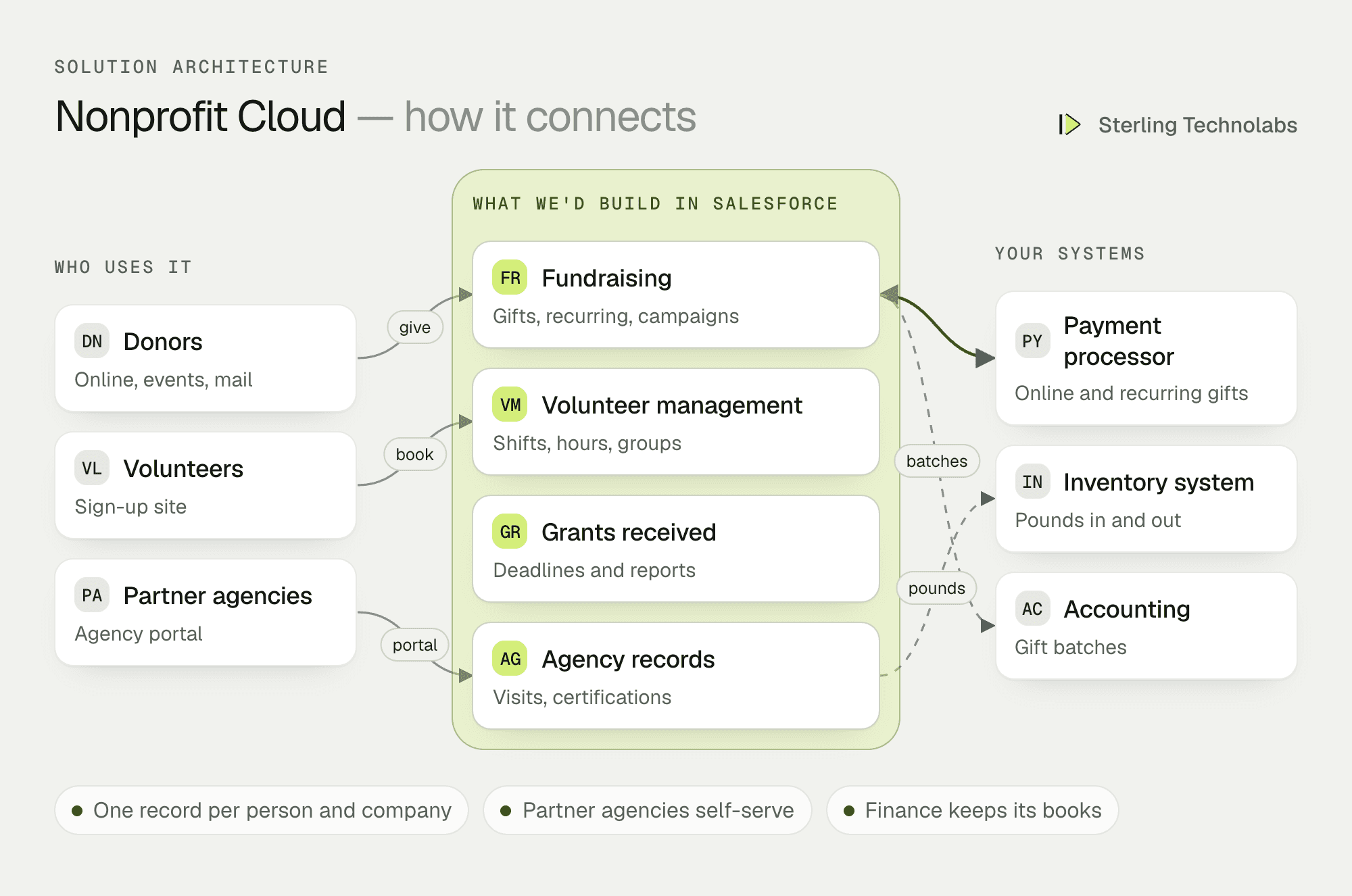
How the pieces fit
One record for every person and company
A person can be a monthly donor, a Saturday volunteer and the contact at a partner pantry. A company can run a food drive, send a volunteer team and give a matching gift. Nonprofit Cloud's data model puts all of that on one person or account record, so a major gifts officer sees volunteer history and a volunteer coordinator sees who is also a donor.
Moving from NPSP to Nonprofit Cloud
Nonprofit Cloud is built on a different data model from NPSP, so it is a new implementation in a new org rather than an upgrade. That is also a chance to drop years of unused fields and workarounds. We'd map every NPSP object and custom field, decide what moves, clean duplicates, and run test loads until the numbers match: donors, gift totals by year, and recurring gifts.
Volunteers without the admin
Volunteers book shifts on a sign-up site, sign waivers online and check in at the warehouse on a tablet. Company and school groups get one link for their whole team. Hours roll up to the person and to the company, which matters for corporate partners who report volunteering to their own boards.
Partner agencies serve themselves
Agency relations staff spend much of their time chasing certificates and updating contact details. In the portal, agencies keep their own details current, upload food safety certificates, see when their next monitoring visit is due, and submit monthly household numbers. Staff get reminders when visits or certificates are due.
Finance and the warehouse keep their systems
The inventory system stays the record for food in and out, and accounting stays the record for money. Pounds donated and distributed come into Salesforce for donor and agency reporting. Gift batches go to accounting, so finance reconciles one batch a day instead of re-keying gifts.
One food drive, end to end
Here is a local company that runs a food drive, sends a volunteer team and makes a gift.
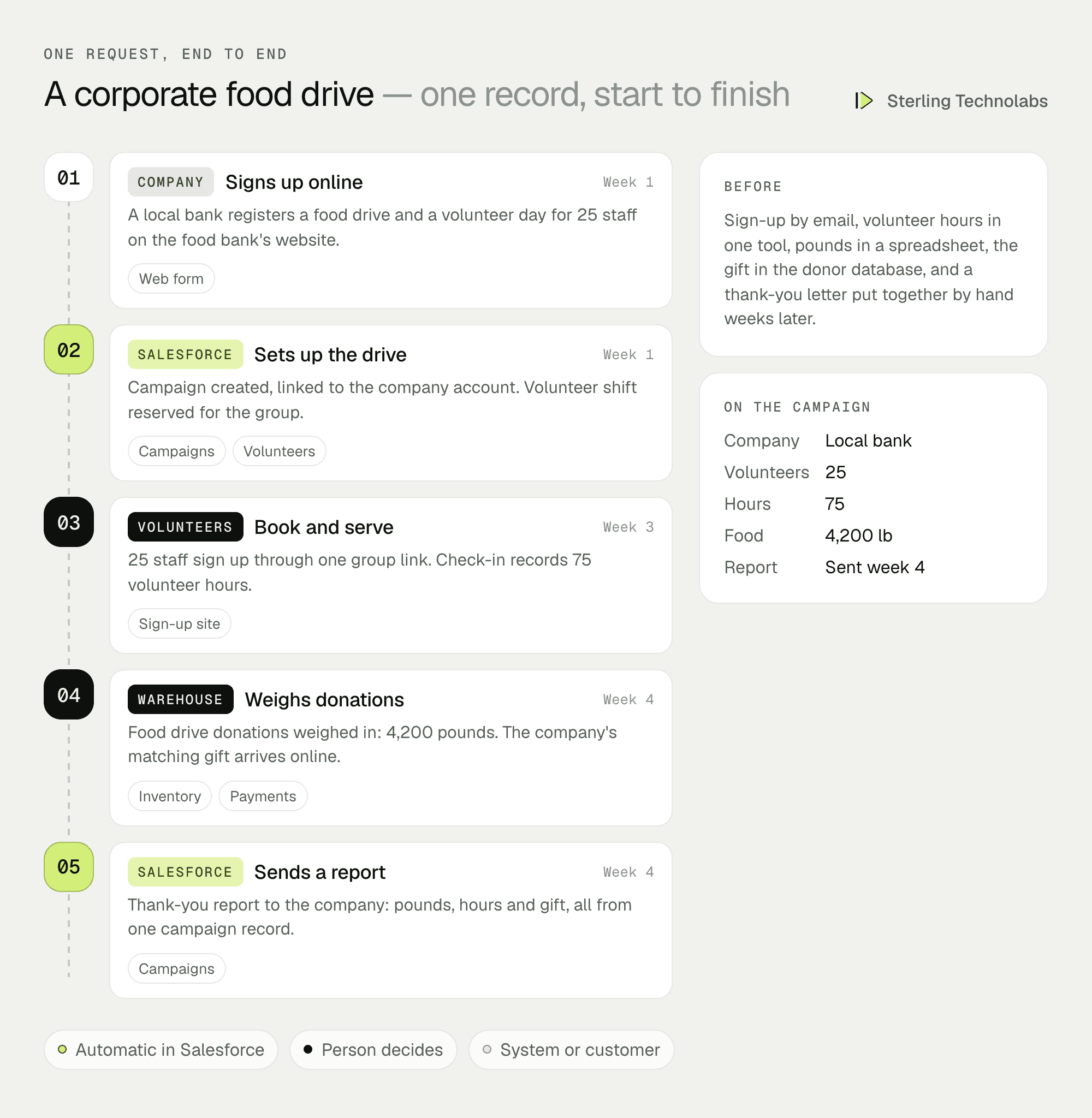
Gifts, volunteer hours and pounds of food all sit on one campaign, so the thank-you report takes minutes instead of an afternoon.
What agency relations staff would see

Agency relations staff see every partner agency with its last monitoring visit, certificates due and status. The fundraising team has its own views of donors, campaigns and grants.
Salesforce for nonprofits: features by team
| Fundraising and grants | Volunteers | Agency relations |
|---|---|---|
| Gifts, pledges and recurring giving | Shift sign-up and waivers | Agency profiles and programs |
| Campaigns, events and food drives | Company and school groups | Monitoring visits |
| Grant deadlines and reports | Check-in and hours | Certificates and agreements |
| Donor history across giving and volunteering | Volunteer history on one record | Self-service agency portal |
Data and integrations
| Data | System of record | Direction | When |
|---|---|---|---|
| Donors, volunteers, agencies, grants | Salesforce Nonprofit Cloud | Salesforce only | Not applicable |
| Online and recurring gifts | Payment processor | To Salesforce | As each gift is made |
| Pounds donated and distributed | Warehouse inventory system | To Salesforce | Nightly |
| Gift batches | Accounting system | Salesforce to accounting | Daily |
| Email lists and results | Email platform | Both ways | Daily |
| Legacy donor history | NPSP org | To Nonprofit Cloud | Once, at go-live |
Delivery plan
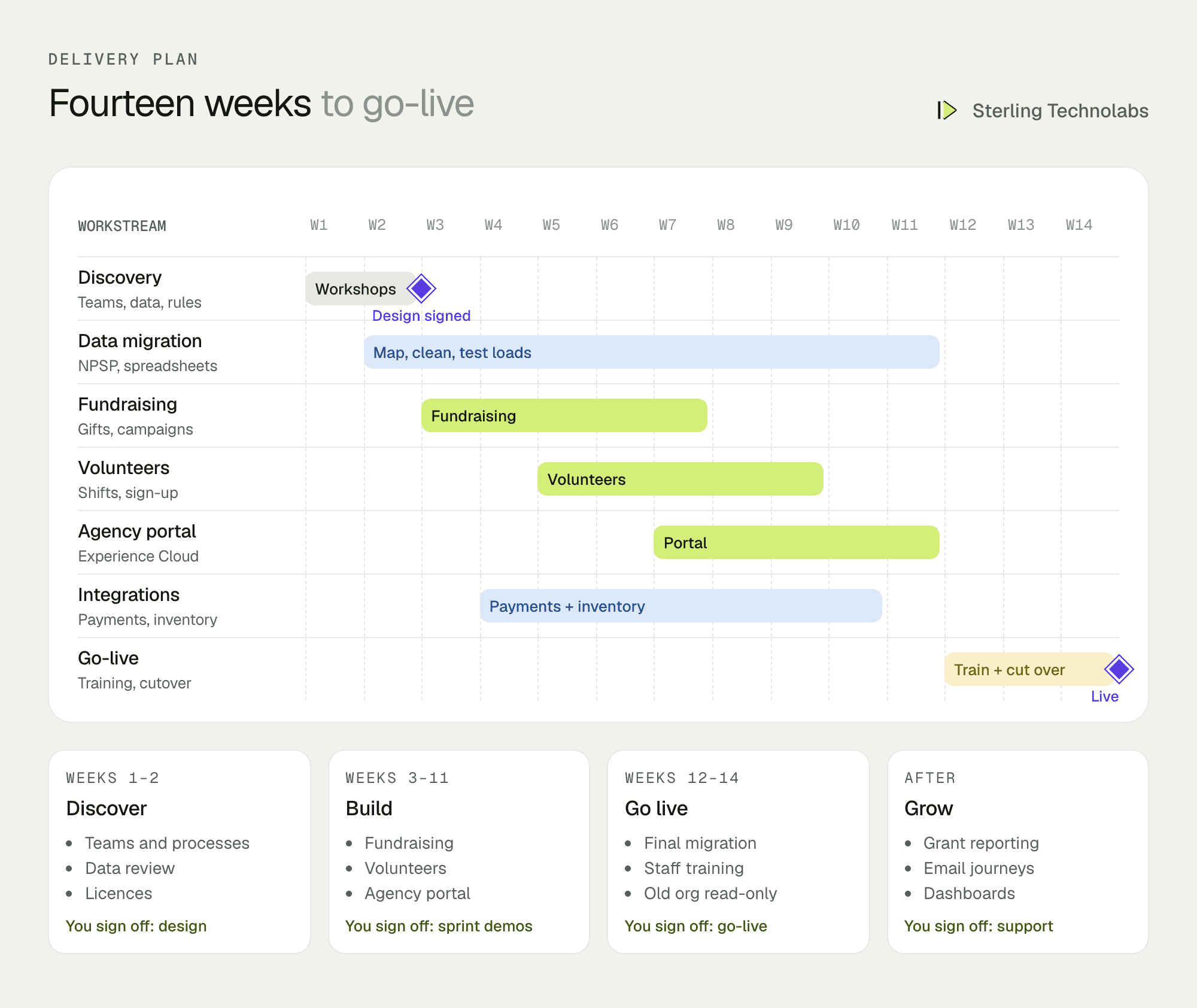
We'd move everything over in one go-live, because running two donor databases side by side creates more problems than it solves. The old org stays read-only for a year as a reference. Grant reporting dashboards and email journeys follow once staff are settled.
The team
| Role | Time | What they own |
|---|---|---|
| Salesforce solution architect | Part time | Nonprofit Cloud design, data model, integrations |
| Business analyst with nonprofit experience | Full time | Fundraising, volunteer and agency processes, UAT |
| Salesforce developer | Full time | Configuration, flows, agency portal |
| Data migration specialist | Weeks 2–14 | NPSP and spreadsheet migration, reconciliation |
| QA engineer | Weeks 7–14 | Test scripts, migration checks, UAT support |
From your side: your development director, volunteer manager, agency relations manager, a finance contact and your current Salesforce admin.
What changes the effort
- Your NPSP org. Heavy customisation and years of data take longer to map and clean.
- Volunteer complexity. Multiple sites, mobile pantries and age rules add setup.
- The agency portal. Profiles and certificates are simple; online agency applications and ordering are more work.
- Integrations. Each payment processor, inventory system and email platform has its own connector or API.
- Licences. Eligible nonprofits get donated and discounted Salesforce licences, and we'd plan users around them.
Risks and how we'd handle them
| Risk | What we'd do |
|---|---|
| Gift totals don't match after migration | Test loads reconciled against the old org by year and fund before go-live. |
| Year-end giving disrupted | Go-live planned outside November and December. |
| Staff keep using spreadsheets | Role-based training, simple page layouts, and old trackers retired at go-live. |
| Agencies don't use the portal | Short onboarding sessions, a one-page guide, and email reminders with direct links. |
| Donor data privacy | Access by team, field-level security on giving data, and audit history. |
What we'd measure
| Metric | How we'd measure it | Baseline from |
|---|---|---|
| Donor retention | Donors who give again the next year | NPSP reports |
| Volunteer return rate | Volunteers who serve more than once a year | Scheduling tool |
| Grant reports on time | Reports submitted by the funder's deadline | Grant spreadsheet |
| Agency compliance | Agencies with a current visit and certificate | Agency folders |
| Time to thank | Days from gift to acknowledgement | Current process |
Build or buy?
Smaller food banks often do well with donor management and volunteer tools built for nonprofits, and we'd say so on the first call. Salesforce Nonprofit Cloud makes sense when you have several teams that need to share records, a large partner network, corporate partners who give in several ways, or an existing Salesforce org that has outgrown NPSP. It is a platform you can extend as programs grow, rather than another separate tool.
Questions we'd ask on the first call
- How many donors, volunteers and partner agencies do you work with each year?
- Are you on NPSP today, and how customised is it?
- Which volunteer, payment, inventory and accounting tools do you use?
- How do you track monitoring visits and agency certificates?
- What do your funders and corporate partners ask you to report?
FAQ
What is Salesforce Nonprofit Cloud?
It is Salesforce's product for nonprofits, covering fundraising, volunteer management, program and outcome management, and grants, on a data model designed for nonprofits.
Can we upgrade from NPSP to Nonprofit Cloud?
Not in place. Nonprofit Cloud uses a different data model, so it is a new org with your data migrated across. Your NPSP org keeps working until you switch.
Is Salesforce good for food banks?
Yes, for food banks with many partner agencies, volunteers and funders. It brings donors, volunteers and agencies into one system, while the warehouse inventory system keeps tracking food.
How long does a Salesforce Nonprofit Cloud implementation take?
For a food bank of this size, with migration from NPSP, volunteers and an agency portal, typically 12 to 14 weeks.
:: Typical stack
Salesforce Nonprofit Cloud, Experience Cloud, Flow, payment processor, warehouse inventory system, accounting integration
:: Related service
Salesforce implementation
See the service

Send us your brief. We’ll help turn it into reality
A senior engineer replies within one business day with questions or a first plan: approach, team, timeline and estimate.
More blueprints like this


