Salesforce Manufacturing Cloud implementation for an industrial equipment maker
Manufacturers that sell through distributors often track volume agreements, forecasts and rebates in spreadsheets. This is how we'd implement Salesforce Manufacturing Cloud so sales, operations and finance plan from the same numbers, with actuals flowing in from the ERP.
Industry
Industrial manufacturing
Typical timeline
14–18 weeks
Typical team
5 people

The situation
Picture an industrial pump and valve manufacturer in Ohio that sells through about 120 distributors across the US and Canada. Most of its revenue is run-rate business: distributors reorder the same product families every month under annual volume commitments. The rest comes from project quotes for plants and municipalities.
The company already uses Salesforce Sales Cloud, but only for opportunities and contacts. The real commercial picture lives elsewhere. Annual volume agreements are PDFs and spreadsheets. Sales reps build their forecasts in Excel by copying last year's orders from the ERP. Distributor rebates are calculated by finance at quarter-end, often weeks late, and distributors regularly dispute the numbers. Nobody can see, during the year, which distributors are falling behind on their commitments.
This is the problem Salesforce Manufacturing Cloud was built for: bringing agreements, forecasts, actual orders and rebates into one place, so sales, operations and finance plan from the same numbers.
Signs this blueprint fits you
- Most of your revenue is recurring orders from distributors or OEM customers, not one-off deals.
- Volume agreements live in spreadsheets, and you can't see actuals against them during the year.
- Sales forecasts are built in Excel and don't match what operations plans for.
- Rebate programs are calculated manually at quarter-end and cause disputes.
- You already have Salesforce, or you're choosing a CRM for a manufacturing business.
What we'd build
- Sales agreements for every distributor's annual commitment, by product family and month, with planned and actual quantities and revenue side by side.
- Account-based forecasting that rolls up from agreements, open opportunities and order history, by distributor, region and product family, with rep adjustments tracked.
- Rebate management for tiered volume rebates and growth incentives, calculated automatically from invoiced sales, with payout statements distributors can check themselves.
- A distributor portal on Experience Cloud where each distributor sees its agreement, progress against tiers, rebate earned to date and open quotes.
- ERP integration so orders, invoices and shipments flow into Salesforce daily, and actuals update without anyone copying them.
- Dashboards for sales leadership and S&OP: forecast versus plan, agreements at risk, rebate liability by quarter.
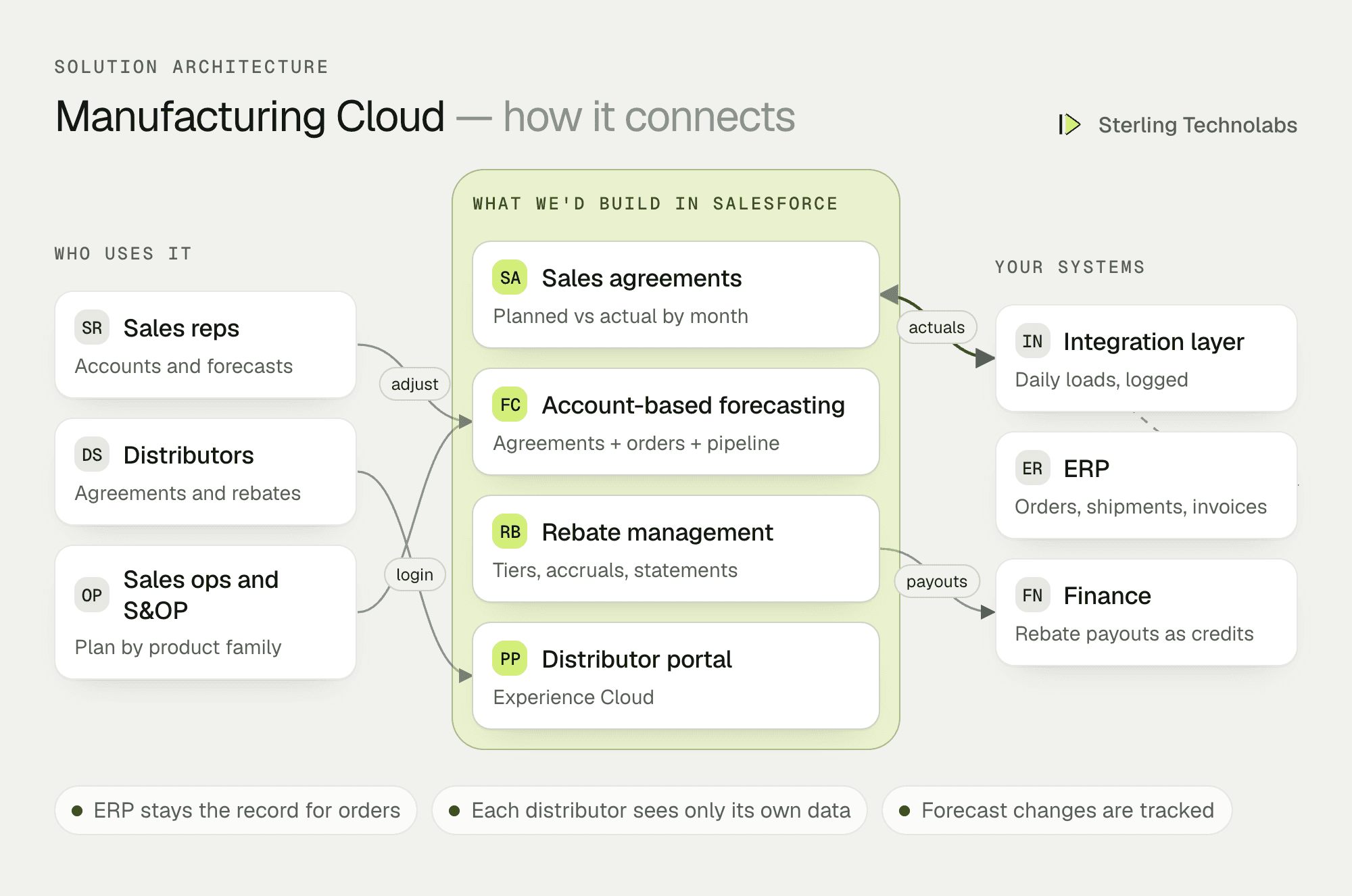
How the pieces fit
The Manufacturing Cloud data model
Manufacturing Cloud adds objects to the standard Salesforce data model. Sales agreements hold the commitment, split into schedules by period and product. Account forecasts combine agreements, opportunities and orders into one forecast per account, recalculated by the platform's data processing engine. Rebate programs define tiers and payout rules, and rebate members link each distributor to the programs it belongs to. Your existing accounts, contacts, products and opportunities stay as they are.
ERP stays the record for orders and invoices
Orders, shipments and invoices are created in the ERP (Epicor, SAP, Microsoft Dynamics or similar) as today. A daily integration loads them into Salesforce as actuals against agreements and as the input to rebate calculations. Salesforce becomes the place to see and plan the commercial relationship; the ERP keeps running fulfilment and billing.
Forecasting that sales and operations both trust
The account forecast starts from what each distributor committed to and what it actually ordered last year. Reps adjust it per account with a reason, and every adjustment is visible. Operations gets a forecast by product family and month that ties back to named customers, which is a much better input to production planning than a spreadsheet total.
Rebates distributors can check
Rebate tiers and accruals are calculated as invoices arrive, not at quarter-end. Distributors see their progress in the portal, so the conversation shifts from disputing a statement to planning the next order to reach a tier.
One agreement, end to end
Here is a distributor's annual commitment followed through a quarter, from signature to a rebate tier being reached.
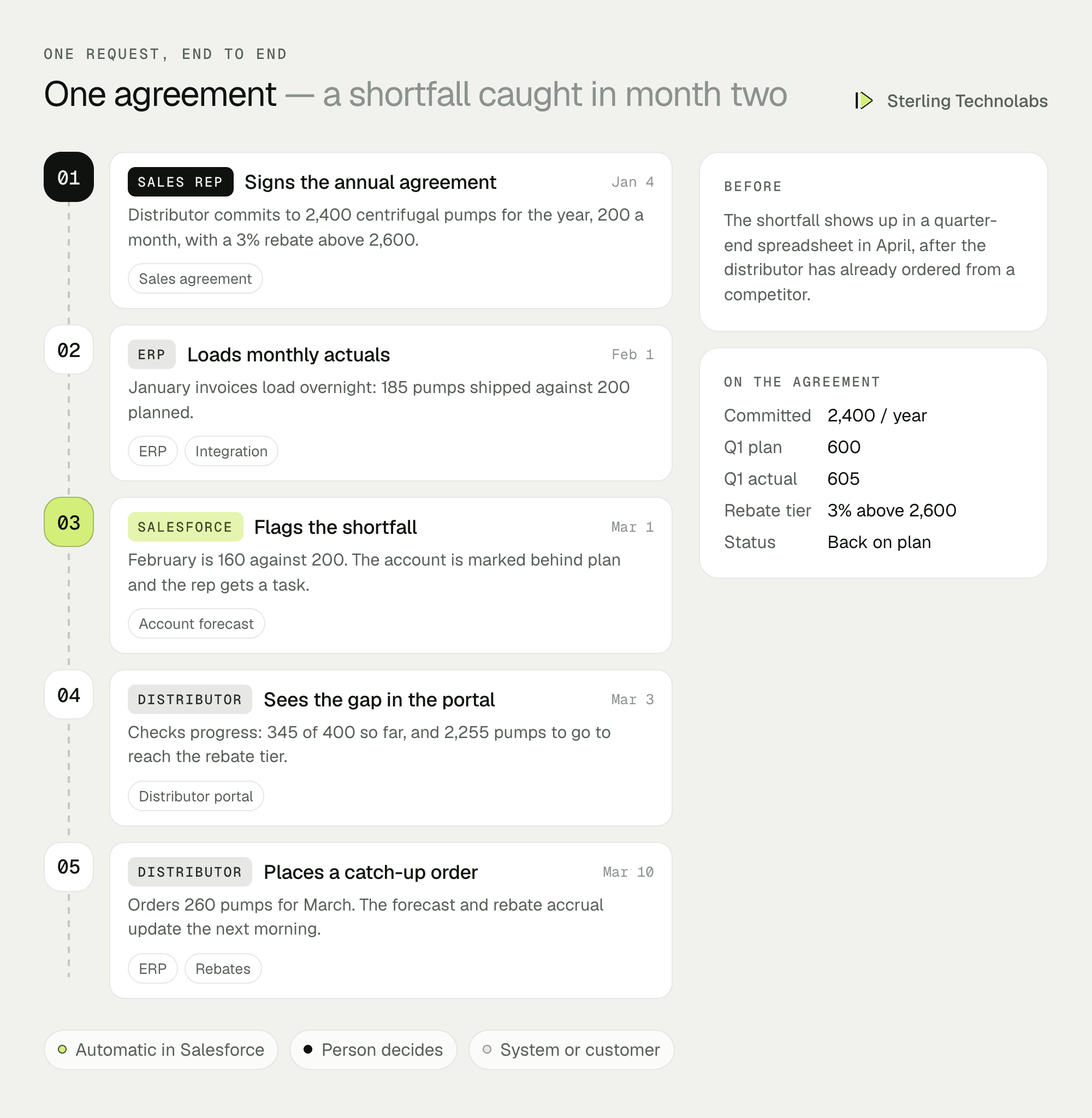
The value is in the middle steps. The sales rep sees the gap in the second month, not after the quarter closes, and the distributor sees exactly how far it is from the next rebate tier. Both have a reason to act early.
What sales teams would see
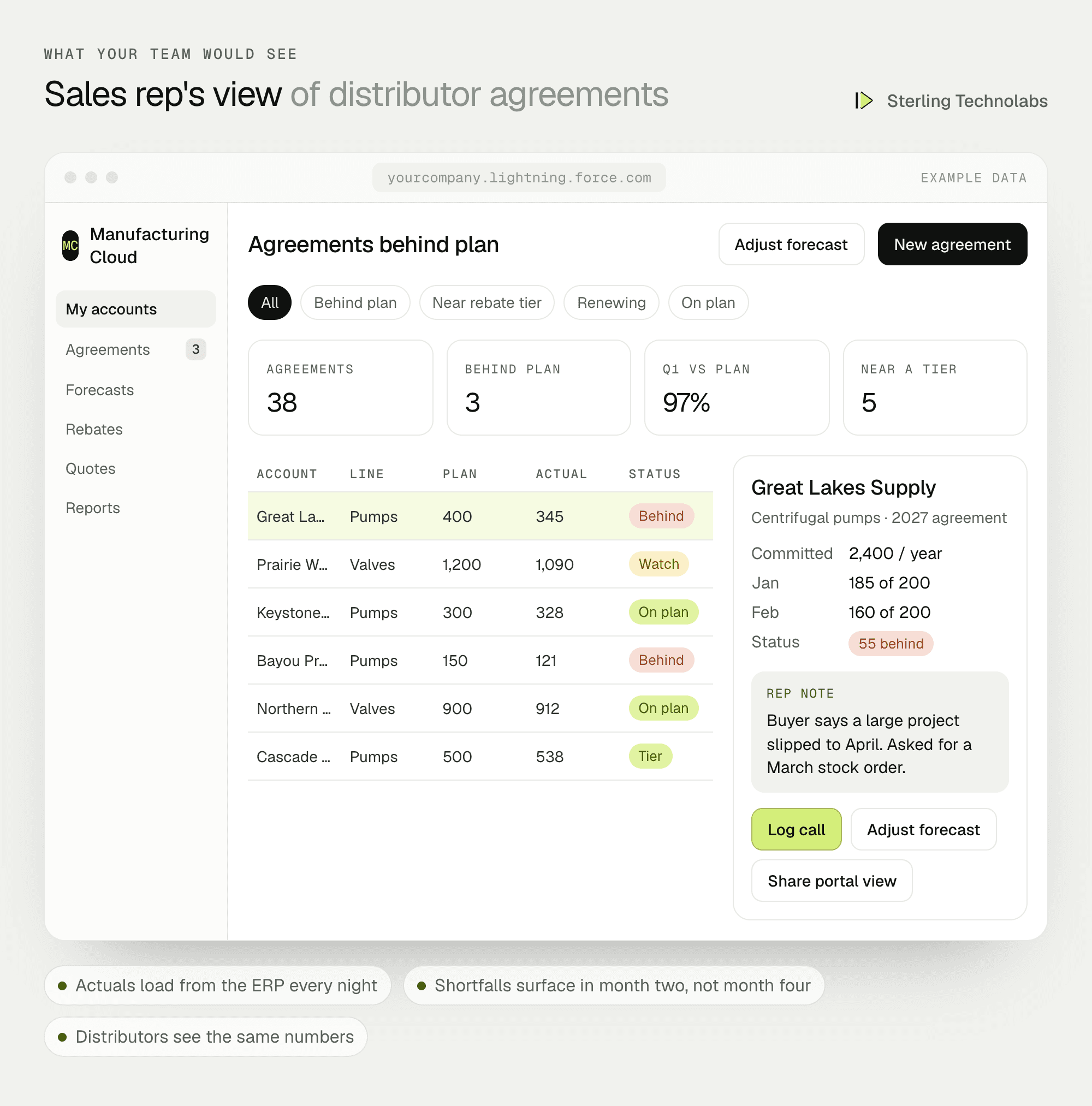
Reps start from their accounts ranked by risk: agreements behind plan, forecasts that changed, distributors close to a rebate tier. Each line opens to the agreement schedule with planned and actual quantities by month.
Data and integrations
| Data | System of record | Direction | When |
|---|---|---|---|
| Accounts, contacts, opportunities | Salesforce | Salesforce only | Not applicable |
| Products and price lists | ERP | ERP to Salesforce | Daily |
| Sales orders and shipments | ERP | ERP to Salesforce | Daily, as agreement actuals |
| Invoices | ERP | ERP to Salesforce | Daily, for rebate accruals |
| Sales agreements and forecasts | Salesforce | Salesforce to planning (optional) | Monthly, for S&OP |
| Rebate payouts | Salesforce | Salesforce to ERP | Quarterly, as credit notes |
Delivery plan
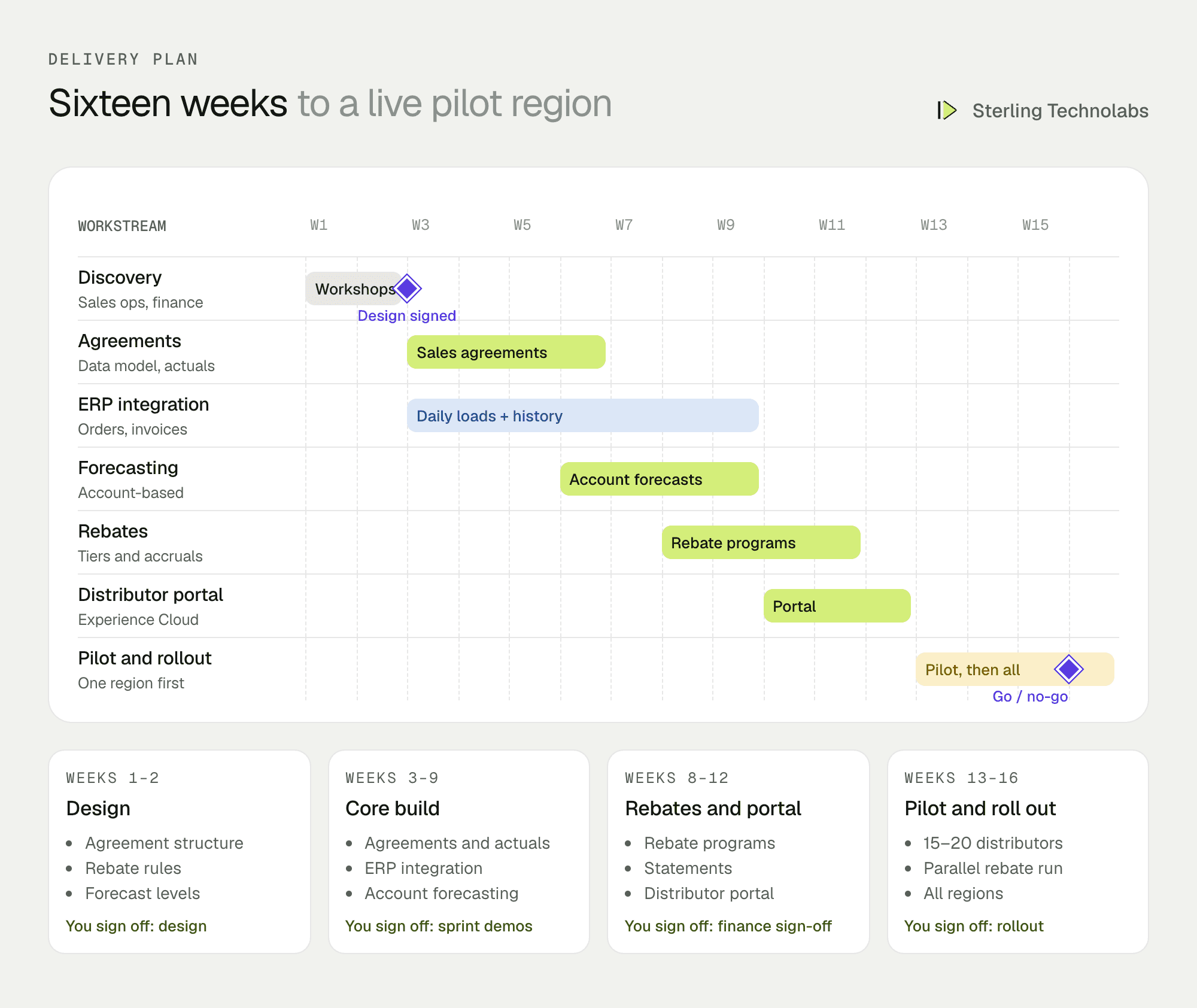
We'd start with sales agreements and actuals, because everything else depends on them. Forecasting comes next, then rebates, then the distributor portal. A pilot region with 15 to 20 distributors goes live before the full rollout, so the data and the rebate math are proven on real accounts first.
The team
| Role | Time | What they own |
|---|---|---|
| Salesforce solution architect | Part time | Data model, forecasting design, integration |
| Business analyst | Weeks 1–14 | Agreement and rebate rules, user stories, UAT |
| Salesforce developers (2) | Full time | Configuration, flows, Lightning components, portal |
| Integration developer | Weeks 3–12 | ERP interfaces, data loads, monitoring |
| QA engineer | Weeks 8–16 | Rebate calculation tests, UAT support |
From your side: a sales operations lead, someone from finance who owns rebates, an ERP specialist for interface specs, and two or three sales reps who will use it every day.
What changes the effort
- Agreement complexity. One agreement per distributor by product family is the simple case. Agreements per ship-to location or per SKU add data and testing.
- Rebate rules. Tiered volume rebates are standard. Growth rebates, product mix incentives and retroactive tiers take longer to set up and test.
- ERP. A modern ERP with an API is quicker to connect than file-based exports.
- History. Loading two or three years of order history improves forecasts but adds data cleaning.
- Portal scope. A read-only portal is a small addition; distributor quoting and ordering in the portal is a phase of its own.
Risks and how we'd handle them
| Risk | What we'd do |
|---|---|
| Actuals don't match the ERP | Daily reconciliation report by distributor and month, checked by finance during the pilot. |
| Rebate disputes | Rebate rules signed off by finance, every accrual traceable to invoice lines, and parallel calculation for one quarter before switching over. |
| Reps keep using spreadsheets | Reps help design the forecast screen, and the spreadsheet forecast is retired on a set date. |
| Licence cost | We size Manufacturing Cloud and Experience Cloud licences to the users who need them in the design phase. |
| Data quality | Products, accounts and distributor hierarchies are cleaned before load, not after. |
What we'd measure
| Metric | How we'd measure it | Baseline from |
|---|---|---|
| Forecast accuracy | Forecast versus actual by product family and month | Last year's spreadsheet forecasts |
| Agreements at risk found early | Accounts flagged behind plan before quarter-end | None flagged today |
| Rebate statement time | Quarter close to statement sent | Current finance process |
| Rebate disputes | Disputed statements per quarter | Finance records |
| Portal use | Distributors logging in each month | Zero today |
Build or buy?
Salesforce Manufacturing Cloud is a licensed product, so the question is really whether it fits your business better than Sales Cloud with custom objects, or a separate rebate tool. It fits best when run-rate business with distributors or OEM customers is a large share of revenue and you want agreements, forecasts and rebates in one model. If most of your business is one-off project sales, Sales Cloud with CPQ is usually the better place to start, and we'd tell you so.
Questions we'd ask on the first call
- What share of revenue is run-rate business under agreements?
- How many distributors or OEM customers, and how are their commitments recorded today?
- How are forecasts built, and who uses them?
- What rebate programs do you run, and how are they calculated?
- Which ERP are you on, and do you already use Salesforce?
FAQ
What is Salesforce Manufacturing Cloud?
It is Salesforce's CRM for manufacturers. On top of Sales Cloud it adds sales agreements, account-based forecasting and rebate management, so commercial commitments, forecasts and actual orders can be managed together.
How long does a Salesforce Manufacturing Cloud implementation take?
A first phase with agreements, forecasting, rebates, ERP integration and a pilot region typically takes 14 to 18 weeks. A smaller start with agreements and forecasting alone can be shorter.
Do we need Manufacturing Cloud if we already have Sales Cloud?
Not always. If you rely on run-rate business and rebates, Manufacturing Cloud saves building those models yourself. If not, Sales Cloud may be enough.
Can distributors use it?
Yes, through an Experience Cloud partner portal where each distributor sees only its own agreements, rebates and quotes.
:: Typical stack
Salesforce Manufacturing Cloud, Sales Cloud, Experience Cloud, Flow, ERP integration via middleware
:: Related service
Salesforce implementation
See the service

Send us your brief. We’ll help turn it into reality
A senior engineer replies within one business day with questions or a first plan: approach, team, timeline and estimate.
More blueprints like this


