Property management software for a build-to-rent operator
Scattered-site rental operators run tours, maintenance and turns outside their property management system. This is how we'd build the operations layer around it: a resident app, self-guided tours, vendor work orders and turns planned from the day notice is given.
Industry
Single-family rental
Typical timeline
16–20 weeks
Typical team
6 people

The situation
Picture a build-to-rent operator with about 3,500 single-family homes and townhomes across Phoenix, Dallas and Atlanta, and plans to double in three years. Unlike an apartment complex, its homes are spread across dozens of neighborhoods with no on-site office. Leasing happens through self-guided tours, maintenance through a network of vendors, and every move-out means a "turn" across town.
The company runs accounting and leases in a mainstream property management system built for multifamily. Everything else sits outside it: tour scheduling and smart-lock codes in one tool, maintenance requests by phone and email, vendor work orders in spreadsheets, turn schedules on a whiteboard, and investor reports assembled by hand each month. Residents have three apps, and the operations team can't tell how long a home sits empty between residents.
The operator doesn't want to replace its accounting system. It wants rental property management software built around how scattered-site rentals actually work, connected to that system.
Signs this blueprint fits you
- Your homes are spread out, with no on-site office or staff.
- Tours, maintenance and turns run in separate tools or spreadsheets.
- Your property management system handles accounting but not operations.
- Vacant days between residents are high and hard to explain.
- You want a resident app under your own brand.
What we'd build
- A resident app for iOS and Android: pay rent, submit maintenance requests with photos, approve entry, see visit times, renew the lease.
- Self-guided touring and applications: tour booking with ID verification, smart-lock codes valid only for the tour slot, online applications with screening through a provider, and e-signed leases.
- Maintenance and vendor management: requests triaged by urgency and trade, work orders sent to vendors with access codes, photos and invoices back in the app.
- Turn management: a move-out inspection on a tablet, scope and cost estimate, vendor schedule and a target ready date for every home.
- Portfolio dashboards: vacant days, turn times, maintenance response, delinquency and renewals, by market.
- Investor reporting with monthly packs by fund or portfolio, generated from live data.
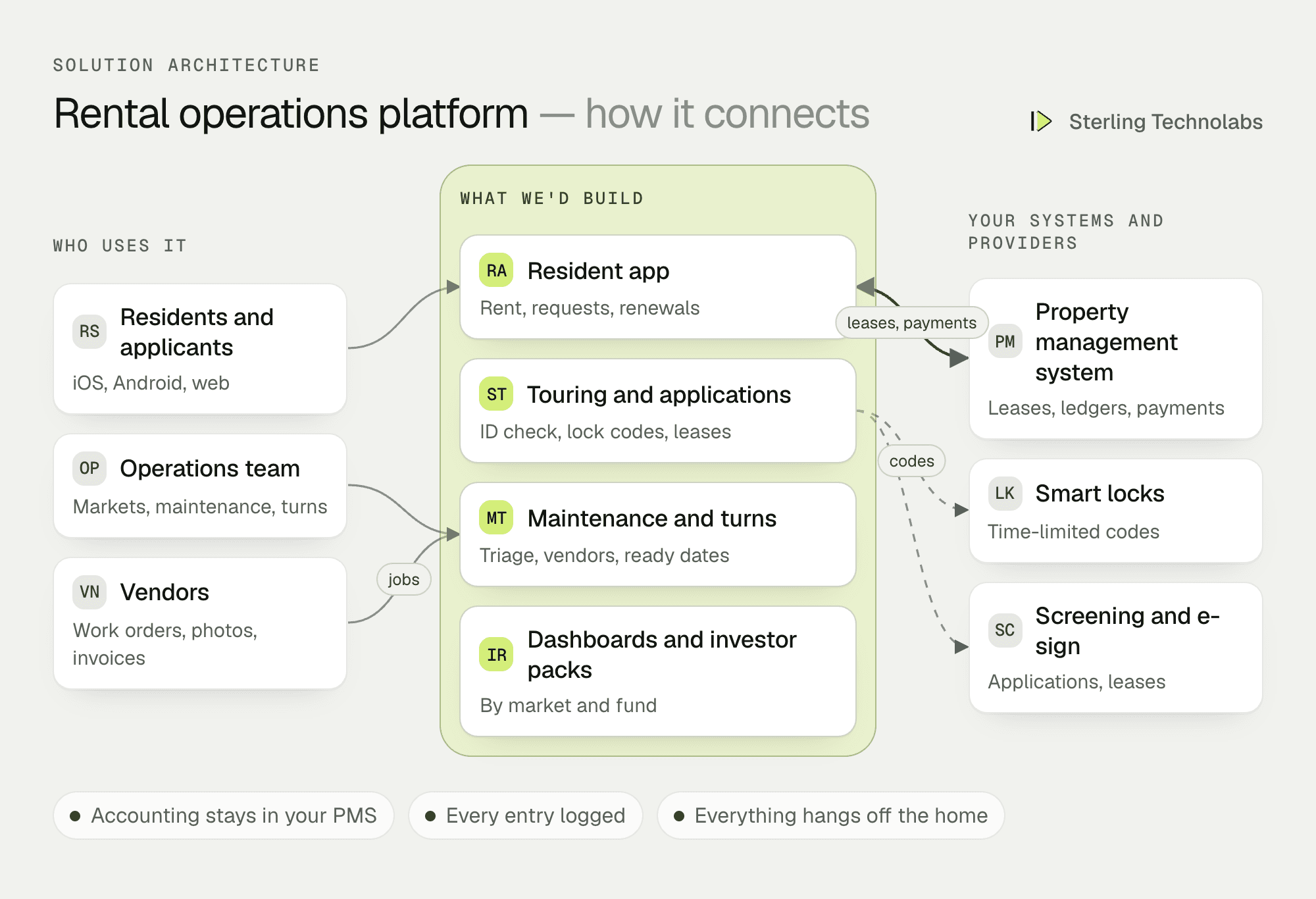
How the pieces fit
Accounting stays in the property management system
Leases, ledgers, rent charges and payments stay in your existing system, such as Yardi, AppFolio, Entrata or RealPage. The new platform reads homes, residents and lease dates through its API, and writes back payments, work order costs and new leases. Your accounting team keeps working where it works today.
Built around the home, not the building
Every record hangs off a home: its address, smart lock, appliances, warranty dates, inspection photos and maintenance history. That is what makes scattered-site work practical. A vendor sent to a home gets the access code, the appliance model and the last visit's notes in one message.
Smart locks and access
Tour and vendor access use time-limited codes from your smart-lock provider. Codes are created for a specific person and window, logged when used, and revoked automatically. Residents approve entry for maintenance visits in the app.
Turns as a schedule, not a whiteboard
When a resident gives notice, the turn starts: pre-move-out inspection, scope, vendor bookings in the right order (repairs, paint, flooring, cleaning), and a ready date. Each delay is visible the day it happens, and leasing can start pre-marketing the home before it's ready.
One turn, end to end
Here is a three-bedroom home in Mesa, from notice to the next resident's move-in.
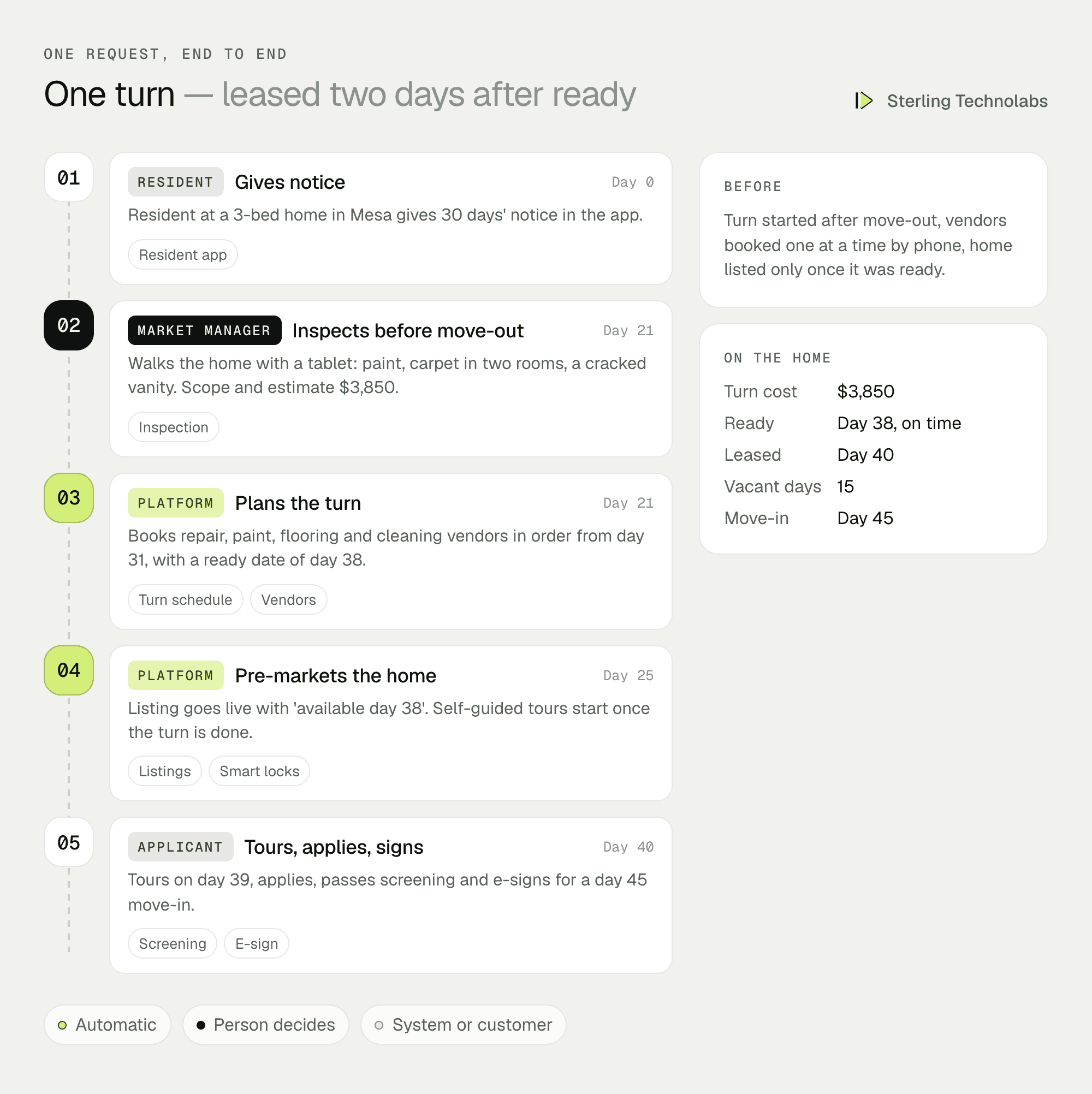
The home was marketed before it was ready and leased within days of completion, because the turn was planned from the day notice was given.
What the operations team would see
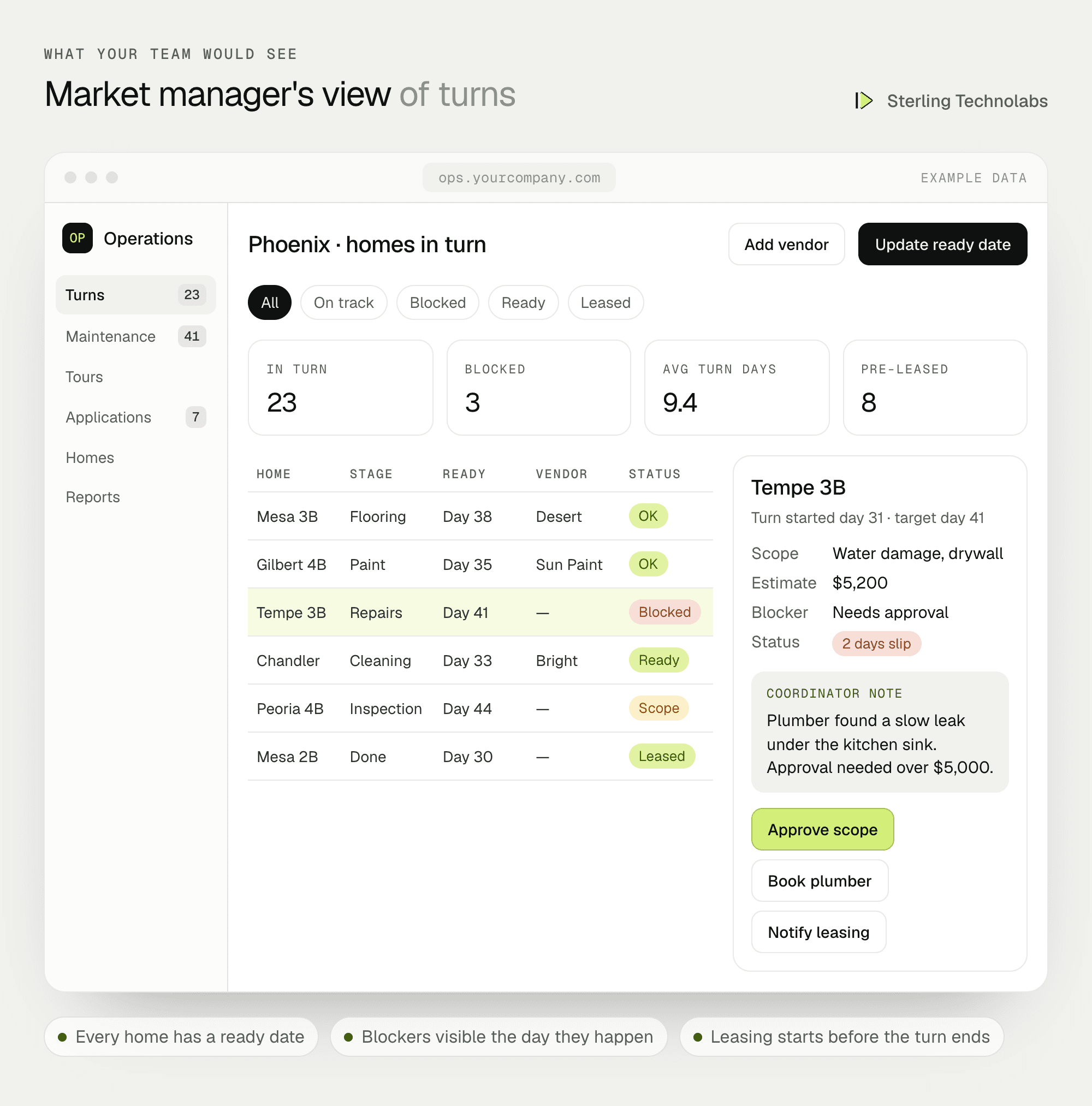
Market managers see every home in turn with its target ready date, vendor bookings and blockers. Maintenance coordinators see open work orders by vendor and age.
Property management software features by user
| Residents and applicants | Operations team | Vendors and investors |
|---|---|---|
| Self-guided tours | Turn schedules and ready dates | Work orders with access codes |
| Applications and e-signed leases | Maintenance triage | Photos and invoices in the app |
| Rent payment and autopay | Vacant days by market | Monthly investor packs |
| Maintenance requests and entry approval | Renewals and delinquency | Portfolio dashboards |
Data and integrations
| Integration | What it's for | Example options |
|---|---|---|
| Property management system | Homes, leases, ledgers, payments | Yardi, AppFolio, Entrata, RealPage |
| Smart locks | Tour and vendor access codes | Your smart-lock provider's API |
| Screening | Credit, background and income checks | Tenant screening provider |
| Identity verification | Self-guided tours | ID verification provider |
| E-signature | Leases and renewals | DocuSign or similar |
| Listings | Marketing available homes | Listing syndication feed |
Delivery plan
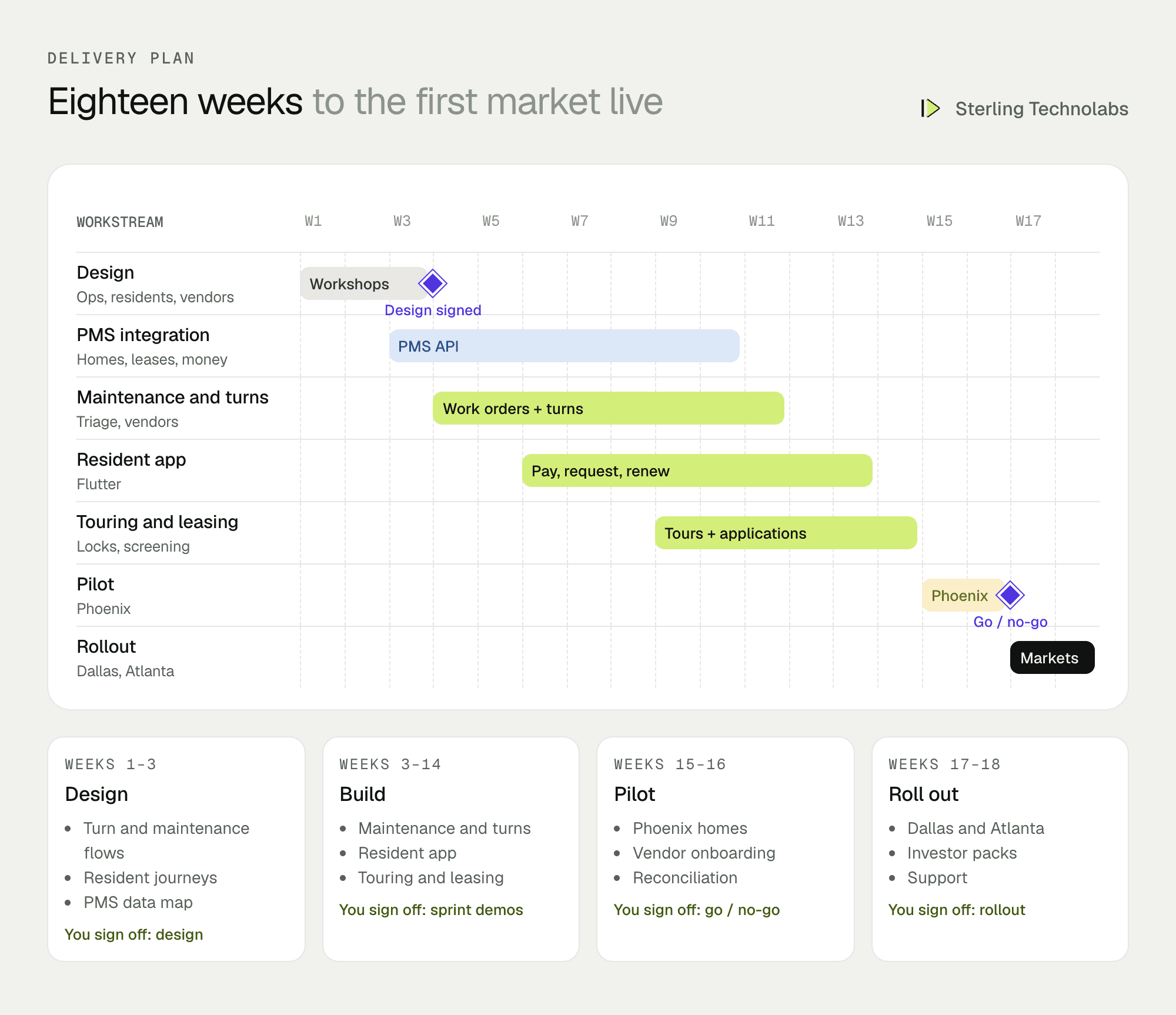
We'd start with maintenance and turns in one market, where vacant days cost the most, and the resident app's maintenance features. Touring, applications and investor reporting follow. Each market moves over once the previous one is running smoothly.
The team
| Role | Time | What they own |
|---|---|---|
| Solution architect | Part time | Architecture, PMS integration, security |
| Business analyst with property experience | Full time | Leasing, maintenance and turn workflows, UAT |
| Product designer | Weeks 1–8 | Resident app and operations screens |
| Flutter developer | Full time | Resident and vendor apps |
| Full-stack developers (2) | Full time | Back end, operations console, integrations |
| QA engineer | From week 6 | Integration tests, device tests, UAT |
From your side: an operations leader, a market manager, a maintenance coordinator, and your PMS administrator.
What changes the effort
- Property management system. Some have open APIs; others need partner access or file exports.
- Scope of the resident app. Maintenance and payments are standard; renewals, community features and add-on services add phases.
- Touring and screening. Self-guided tours add identity, lock and fraud checks.
- Vendor network. A vendor app is more work than email work orders, but gives better photos and timing.
- Investor reporting. Several funds with different reporting formats add work.
Risks and how we'd handle them
| Risk | What we'd do |
|---|---|
| Tour fraud | ID verification before codes are issued, codes valid only for the slot, and every entry logged. |
| Data out of sync with accounting | The PMS stays the record for leases and money, and a daily reconciliation report checks both sides. |
| Fair housing issues | Screening criteria set by you and applied the same way to every applicant, with decisions logged. |
| Vendors don't use the app | Email and text work orders as a fallback, with photos uploaded by link. |
| Resident data exposure | Encryption, access by role, audit logs and only the data each user needs. |
What we'd measure
| Metric | How we'd measure it | Baseline from |
|---|---|---|
| Vacant days | Move-out to next move-in | PMS lease dates |
| Turn time | Move-out to ready date | Turn spreadsheet |
| Maintenance response | Request to first vendor visit, by urgency | Email and phone logs |
| Tour to application rate | Applications per completed tour | Tour tool reports |
| Renewal rate | Leases renewed as a share of those expiring | PMS reports |
Build or buy?
Mainstream property management systems are the right core for accounting and leases, and for most landlords their add-ons are enough. Custom property management software development makes sense for operators with scattered-site portfolios, fast growth, or operating models that don't fit multifamily software, and for those who want a resident experience under their own brand. The usual answer is to keep the PMS and build the operations layer around it.
Questions we'd ask on the first call
- How many homes, in which markets, and how fast are you growing?
- Which property management system do you use?
- How do tours, maintenance and turns run today?
- Which smart locks and screening providers do you use?
- What do investors ask for every month?
FAQ
Should we build property management software or buy it?
Most landlords should buy. Build when your operating model, such as scattered-site build-to-rent, doesn't fit the products, and keep your existing system for accounting.
Can custom software work with Yardi or AppFolio?
Yes, through their APIs or partner programs. Leases and accounting stay there; operations run in the new platform.
How long does property management software development take?
A first release for one market, with maintenance, turns and the resident app, typically takes 16 to 20 weeks.
Does it support self-guided tours?
Yes, with identity verification, time-limited smart-lock codes and a log of every entry.
:: Typical stack
Flutter, React, Node.js, PostgreSQL, PMS API (Yardi, AppFolio or similar), smart-lock API, screening and e-sign providers
:: Related service
Custom software development
See the service

Send us your brief. We’ll help turn it into reality
A senior engineer replies within one business day with questions or a first plan: approach, team, timeline and estimate.
More blueprints like this


