Patient portal for a multi-specialty medical group
Medical groups built by acquisition give patients a portal per EHR. This is how we'd build one patient portal and app across every clinic, with booking, intake, results, messages and bill pay, while staff keep working in their EHRs.
Industry
Healthcare providers
Typical timeline
18–22 weeks
Typical team
7 people

The situation
Picture a multi-specialty medical group in Ohio with 40 clinics, 300 providers and about 450,000 patients. It covers primary care, pediatrics, cardiology, dermatology, orthopedics and women's health. It has grown by bringing in independent practices, and three EHRs are still in use: one for primary care and pediatrics, one for most specialties, and one at a group of orthopedic clinics that joined two years ago.
Each EHR comes with its own patient portal. A family that sees a pediatrician, a cardiologist and an orthopedic surgeon in the same group has three logins, three apps and three ways to pay a bill. Most patients still book by phone, which keeps call center hold times long. Intake is done on paper in the waiting room. Parents can't easily manage their children's care, and adult children can't help ageing parents. Patient surveys keep mentioning the same thing: it is hard to deal with the group as one organisation.
Moving everything to one EHR is years away. The group wants custom patient portal development now: one branded portal and app across all clinics, connected to all three EHRs.
Signs this blueprint fits you
- You run more than one EHR after mergers or acquisitions.
- Patients juggle several portals, logins or apps.
- Most appointments are still booked by phone.
- Intake and consent forms are done on paper.
- Families can't manage care for children or parents in one place.
What we'd build
- A patient portal on the web and a mobile app for iOS and Android under the group's brand, with one login for every clinic and specialty.
- Identity verification and proxy access: patients verify who they are once, and parents, guardians and caregivers get access to the records they're allowed to see.
- Online scheduling across specialties, using real availability from each clinic's EHR and the booking rules each specialty sets.
- Digital intake: demographics, medications, allergies, history questionnaires, consent forms and insurance card photos, completed at home and written back to the EHR.
- Results, visit summaries and records from all three EHRs in one timeline.
- Secure messaging that reaches the right clinic's inbox in its EHR.
- Bill pay for statements from every clinic, with saved cards and payment plans.
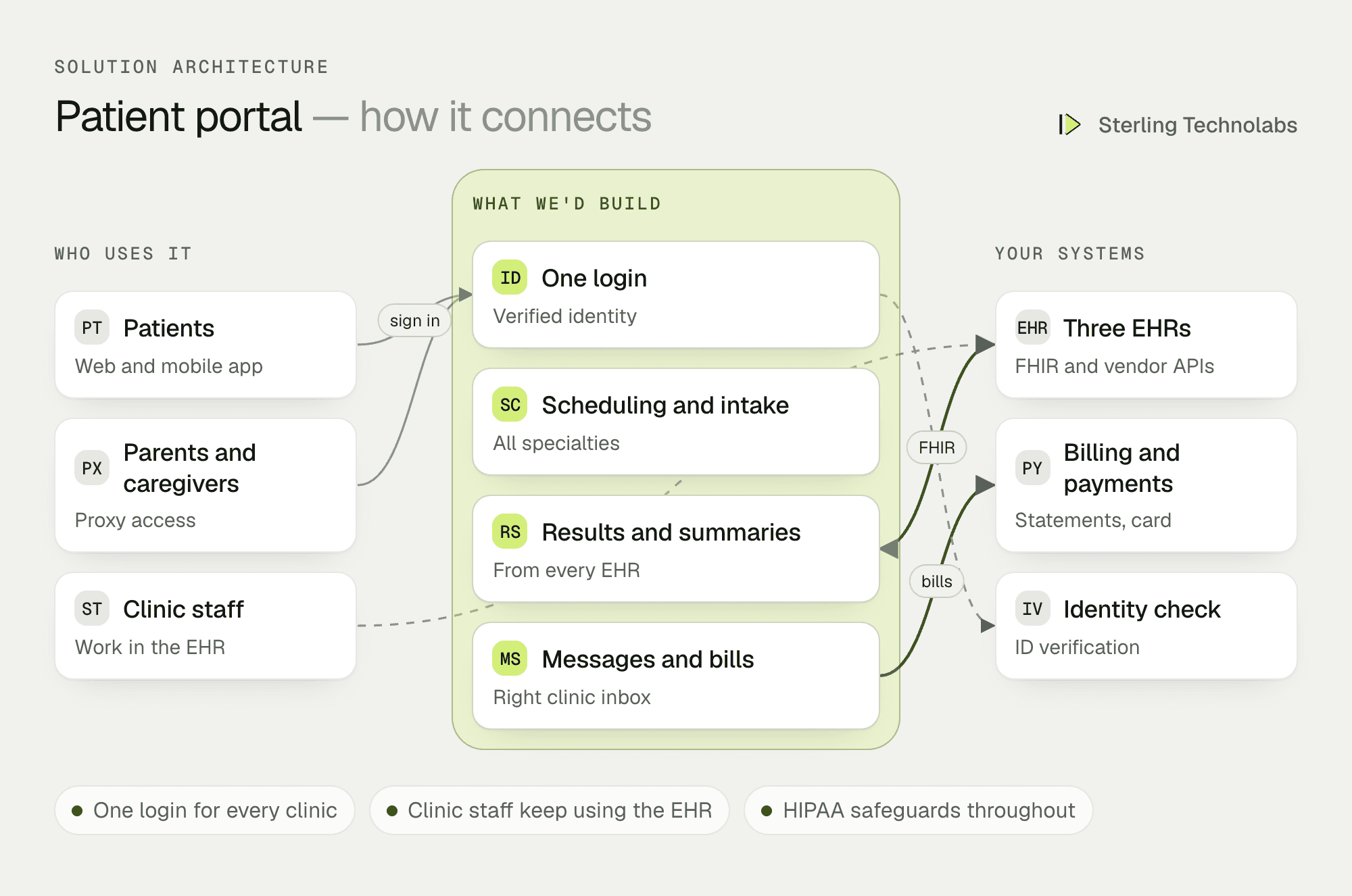
How the pieces fit
The EHRs stay the record
Clinicians and staff keep working in their EHRs. The portal reads appointments, results, medications and visit summaries through each EHR's FHIR API, which certified EHRs provide for patient access, and uses vendor APIs where FHIR doesn't cover a task, such as booking or writing intake back. Nothing clinical is stored in the portal longer than it needs to be.
One patient, matched across EHRs
The same person may have a different record number in each EHR. When a patient signs up and verifies their identity, the portal links their records across systems using a matching process the group's health information team approves, with uncertain matches reviewed by a person. Once linked, the patient sees all their care in one place.
Scheduling with each specialty's rules
Primary care lets patients book most visit types directly. Specialties often need a referral or a few screening questions first. Each clinic sets which visit types can be booked online, with which providers, and what to ask. Anything outside the rules becomes a request the clinic answers.
Security and privacy throughout
The portal runs on HIPAA-eligible cloud services under a business associate agreement. Every access to patient data is logged, sessions time out, and multi-factor sign-in protects accounts. Proxy access follows your policies, including the change in what parents can see when a child becomes a teenager. An independent security test is done before launch.
One visit, end to end
Here is a patient booking a dermatology visit at a clinic she hasn't used before.
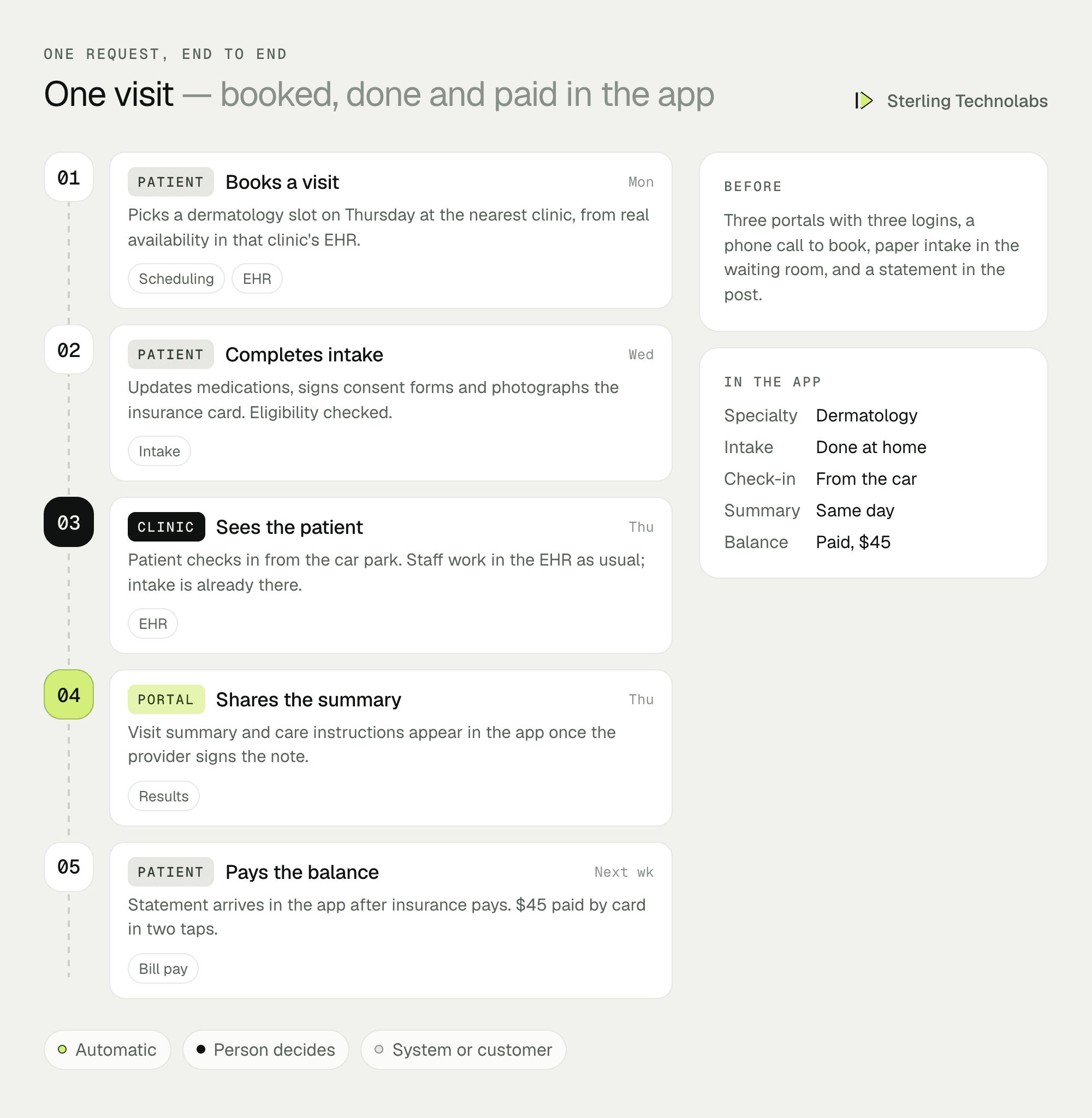
The patient never filled in a paper form or made a phone call, and the clinic's staff worked in their EHR exactly as before.
What patients would see
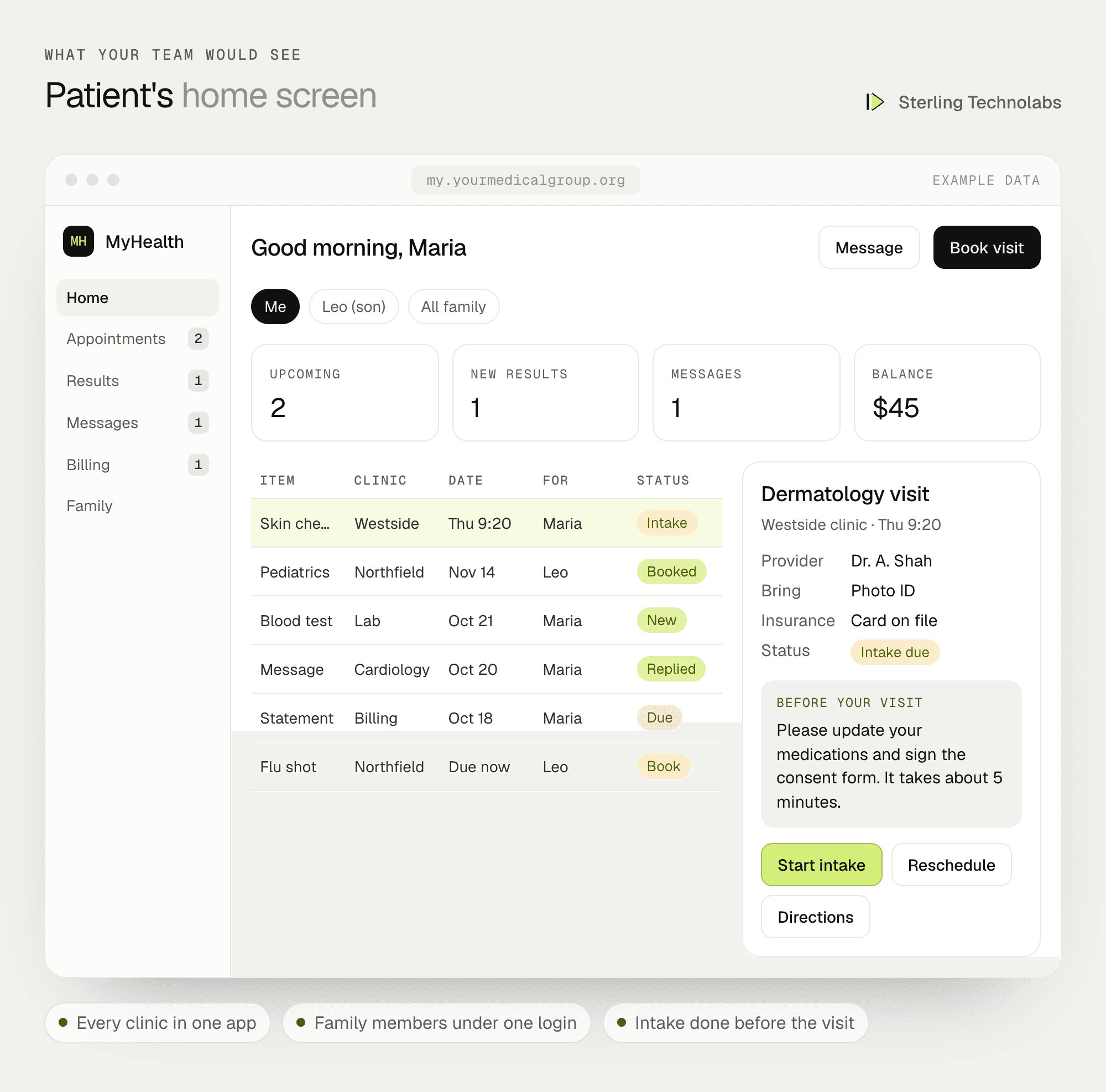
Patients see upcoming visits, new results, messages and bills across every clinic, for themselves and the family members they manage.
Patient portal features by user
| Patients | Parents and caregivers | Clinics and the group |
|---|---|---|
| Book across specialties | Switch between family members | Fewer booking calls |
| Intake and consent at home | Manage children's visits and forms | Intake written to the EHR |
| Results and summaries in one timeline | Help ageing parents with permission | Messages in the right inbox |
| Pay any clinic's bill | Reminders for everyone | One brand across all clinics |
Data and integrations
| Integration | What it's for | Example options |
|---|---|---|
| EHR FHIR APIs | Results, medications, summaries, appointments | athenahealth, eClinicalWorks, NextGen |
| EHR vendor APIs | Booking, intake write-back, messages | Each vendor's partner program |
| Billing system | Statements and balances | Your practice management or RCM system |
| Payments | Card payments and payment plans | Payment processor with healthcare support |
| Identity verification | Account sign-up | ID verification provider |
| Insurance eligibility | Coverage checks before visits | Clearinghouse API |
Delivery plan
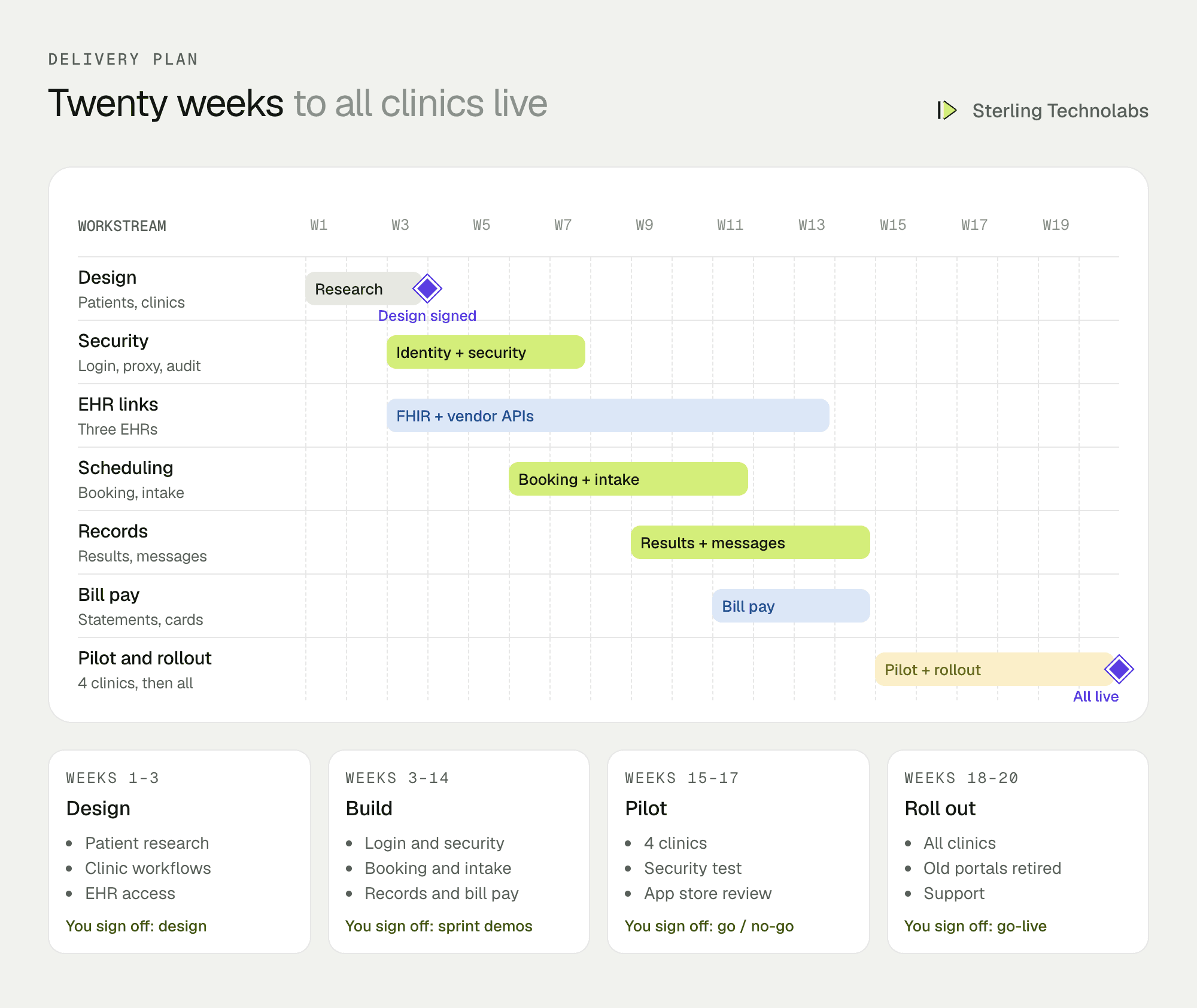
We'd pilot at four clinics, one on each EHR plus a pediatric clinic for proxy access, before rolling out group-wide. Old portals are switched off clinic by clinic once patients have moved across.
The team
| Role | Time | What they own |
|---|---|---|
| Solution architect | Part time | Architecture, EHR integrations, security |
| Business analyst with healthcare experience | Full time | Clinic workflows, scheduling rules, UAT |
| Product designer | Weeks 1–10 | Patient research, app and portal screens, accessibility |
| Mobile developer | Full time | iOS and Android app |
| Back-end developers (2) | Full time | EHR integrations, patient matching, bill pay |
| QA engineer | From week 6 | Integration tests, accessibility, security test support |
From your side: a patient experience lead, a clinic operations manager, your health information management lead, someone from each EHR's admin team, and your privacy officer.
What changes the effort
- Number of EHRs. Each EHR adds an integration and its own testing.
- Write-back. Reading records through FHIR is standard; booking and intake write-back depend on each vendor's APIs.
- Scheduling rules. Primary care is simple; specialties with referrals and screening questions take longer.
- Proxy access. Adolescent privacy rules and caregiver access need careful design.
- Languages and accessibility. Each language adds content and testing; WCAG accessibility is built in from the start.
Risks and how we'd handle them
| Risk | What we'd do |
|---|---|
| Wrong patient records linked | Identity verification at sign-up, conservative matching, and manual review of uncertain matches. |
| Data breach | HIPAA safeguards, encryption, multi-factor sign-in, audit logs and an independent security test. |
| EHR vendor limits | API access confirmed with each vendor in the first weeks, with fallbacks where write-back isn't offered. |
| Results released too early | Release rules follow your policies and federal information blocking rules, agreed with providers. |
| Patients keep calling | Booking links in reminders and texts, and call center staff helping patients sign up. |
What we'd measure
| Metric | How we'd measure it | Baseline from |
|---|---|---|
| Portal adoption | Active patients as a share of those seen | Current portal reports |
| Online booking | Appointments booked online | EHR scheduling reports |
| Call volume | Booking calls to the call center | Phone system |
| Intake completed before visit | Visits with intake done at home | Front desk sampling |
| Days to collect patient balances | Statement to payment | Billing system |
Build or buy?
If you run one EHR, its own patient portal is usually the right answer, and we'd suggest improving how you use it. Custom patient portal development makes sense when you run several EHRs, want one brand and app across all clinics, or need features the EHR portals don't offer. Third-party portal products exist too; we'd compare them with a custom build on the first call.
Questions we'd ask on the first call
- How many clinics, specialties and EHRs do you run?
- What do patients complain about most today?
- Which tasks do you want online first: booking, intake, results or bills?
- Do your EHR vendors offer APIs beyond FHIR read access?
- How do you handle proxy access for children and caregivers today?
FAQ
What is patient portal development?
Building a secure website and app where patients book visits, complete forms, see results, message their care team and pay bills, connected to the practice's EHR.
Can one patient portal work with several EHRs?
Yes. It reads records through each EHR's FHIR API and uses vendor APIs for booking and write-back, so patients see all their care in one place.
Is a custom patient portal HIPAA compliant?
It can be, with HIPAA-eligible hosting under a business associate agreement, encryption, access controls, audit logs and a security test before launch.
How long does patient portal app development take?
For a group with three EHRs, a web portal and mobile app with booking, intake, results, messaging and bill pay typically takes 18 to 22 weeks.
:: Typical stack
React, React Native, Node.js, FHIR APIs, EHR vendor APIs (athenahealth, eClinicalWorks, NextGen), payment processor, ID verification, HIPAA-eligible cloud
:: Related service
Mobile app development
See the service

Send us your brief. We’ll help turn it into reality
A senior engineer replies within one business day with questions or a first plan: approach, team, timeline and estimate.
More blueprints like this


