Fleet management software for a waste and recycling hauler
Haulers with telematics still run inspections, maintenance and service proof on paper. This is how we'd build fleet management software that connects drivers, shops, dispatch and billing, using the telematics already in the trucks.
Industry
Waste and recycling
Typical timeline
16–18 weeks
Typical team
6 people

The situation
Picture a regional waste and recycling hauler in Georgia with 220 trucks running from four yards: automated side loaders for residential routes, front loaders for commercial dumpsters, and roll-off trucks for construction containers. It serves about 180,000 homes and 6,000 businesses, and runs its own shop in each yard.
The trucks already have telematics units and electronic logging devices, and the company has a billing system for customers. Everything between them is on paper or in people's heads. Drivers fill in inspection sheets that the shop reads hours later. Defects are reported by radio. Preventive maintenance is tracked in a spreadsheet, and trucks miss service because nobody saw the mileage. When a customer says their bin was missed, there's no proof either way. Route changes are written on whiteboards, and service data is typed into billing the next morning.
Off-the-shelf fleet tools covered parts of this, but not the waste-specific work of service confirmation, missed pickup proof and billing. The hauler wants custom fleet management software that connects its trucks, drivers, shops and billing.
Signs this blueprint fits you
- You run a large fleet with its own shops, and maintenance lives in spreadsheets.
- Driver inspections are on paper, and defects reach the shop late.
- You have telematics data but use little of it.
- Customers dispute service and you lack proof.
- Route and service data is re-typed into billing.
What we'd build
- A driver app on in-cab tablets: electronic pre-trip and post-trip inspections with photos, the day's route, service confirmation for each stop, and photos of exceptions such as blocked or overflowing bins.
- Routes and stops: daily route plans from your routing data, with changes pushed to drivers and stops moved between trucks during the day.
- Maintenance management: defects become work orders, preventive maintenance is scheduled by mileage, hours and date, and parts and labour are logged per truck.
- A live dispatch board showing every truck, route progress, exceptions, engine alerts and trucks in the shop.
- Fleet reports: cost per truck and per route, fuel use, idling, safety events and maintenance compliance.
- Integrations with telematics and ELD providers, fuel cards and the customer billing system.
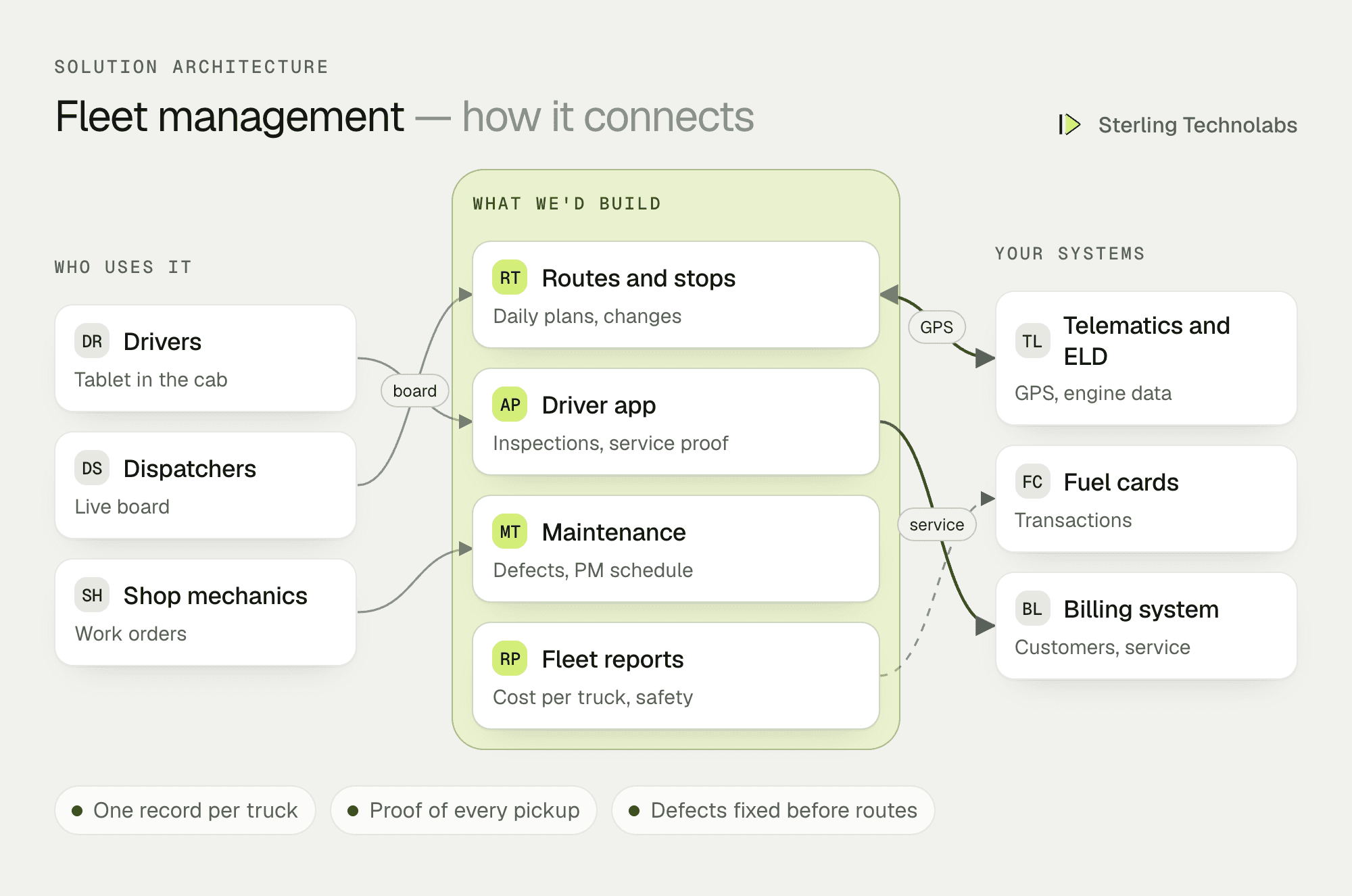
How the pieces fit
Use the telematics you already pay for
Telematics units already send location, speed, engine hours, fault codes and, on many trucks, arm or lift sensor signals. We'd bring that data into the fleet system through the provider's API rather than adding new hardware. Location and arm sensors confirm service at each stop; fault codes create alerts for the shop. Hours of service stay in the certified ELD, as the rules require.
Inspections that reach the shop instantly
Drivers complete inspections on the tablet, with photos for any defect. A defect that affects safety creates a work order and alerts the shop before the truck leaves the yard. The shop lead decides whether the truck goes out, gets fixed first or is swapped for a spare. Every inspection is stored for the retention period regulators require.
Proof for every pickup
Each stop is confirmed by the arm sensor or the driver, with time and location. When a bin is blocked, overloaded or not out, the driver takes a photo in two taps. Customer service sees the proof when a customer calls, and billing gets accurate service records for extra pickups and charges.
Maintenance planned, not remembered
Preventive maintenance schedules are set by truck type and run on real mileage and engine hours from telematics. The shop sees what is due this week in each yard, and parts and labour build a cost history for every truck, which helps decide when to replace one.
One route day, end to end
Here is a residential side loader starting its day.
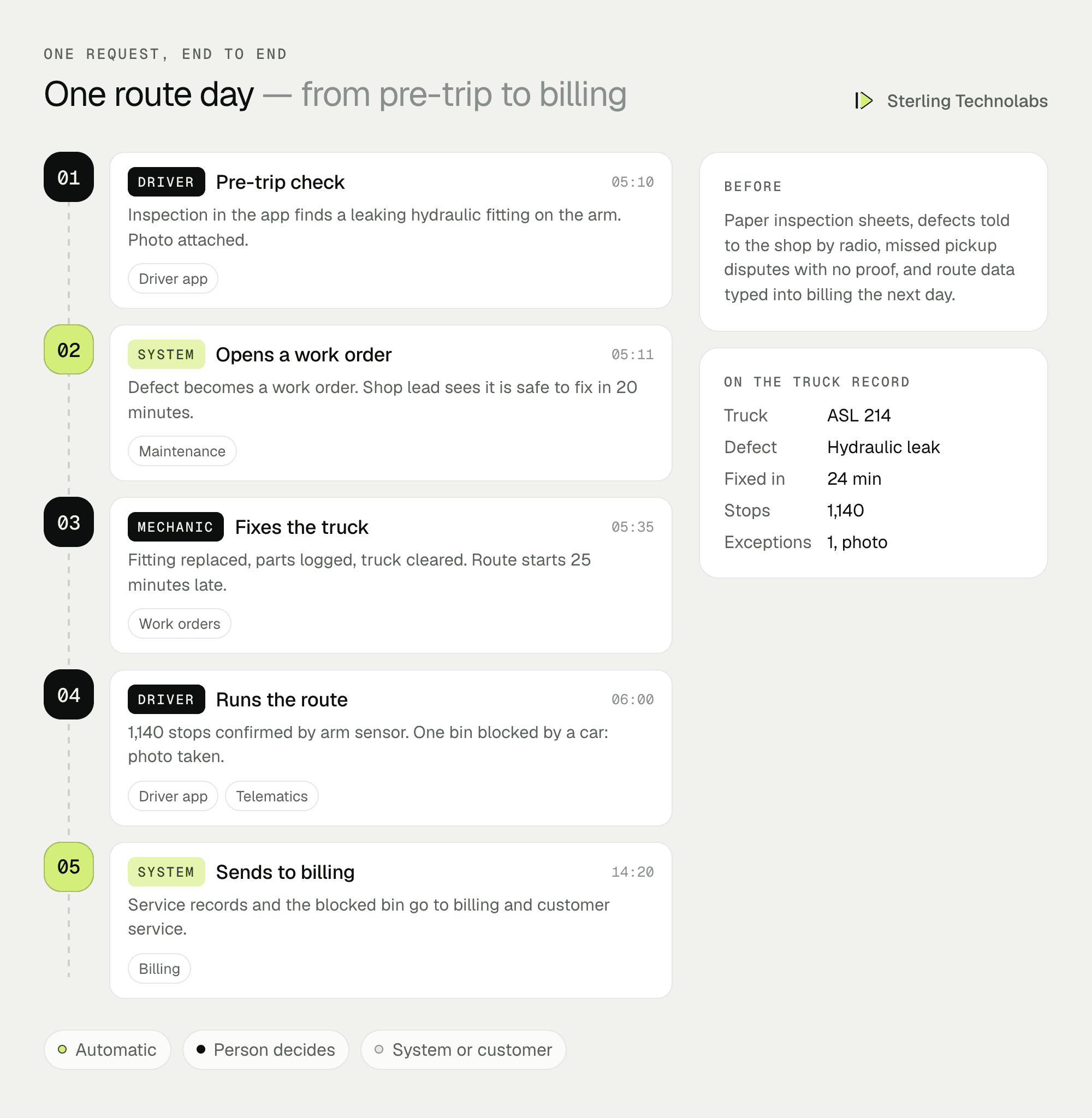
The defect was fixed before the truck left the yard, and the day's service records reached billing with proof of the one exception.
What dispatchers would see

Dispatchers see every truck's progress, exceptions with photos, engine alerts and spare trucks. Shop leads see defects and due maintenance; managers see cost and safety reports.
Fleet management software features by role
| Drivers | Dispatch and customer service | Shop and managers |
|---|---|---|
| Inspections with photos | Live route progress | Defects as work orders |
| Route and stop list | Move stops between trucks | Preventive maintenance schedule |
| Service confirmation | Proof for missed pickup calls | Cost per truck and route |
| Exception photos | Messages to drivers | Fuel, idling and safety reports |
Data and integrations
| Integration | What it's for | Example options |
|---|---|---|
| Telematics | Location, engine data, fault codes, arm sensors | Your provider's API, such as Samsara or Geotab |
| ELD | Hours of service, kept in the certified device | Your ELD provider |
| Cameras | Safety events and video | Your camera provider |
| Fuel cards | Fuel use and cost per truck | WEX, Corpay or similar |
| Billing system | Customers, service records, extra charges | Your hauler billing system |
| Parts suppliers | Parts prices and orders | Supplier catalogues |
Delivery plan
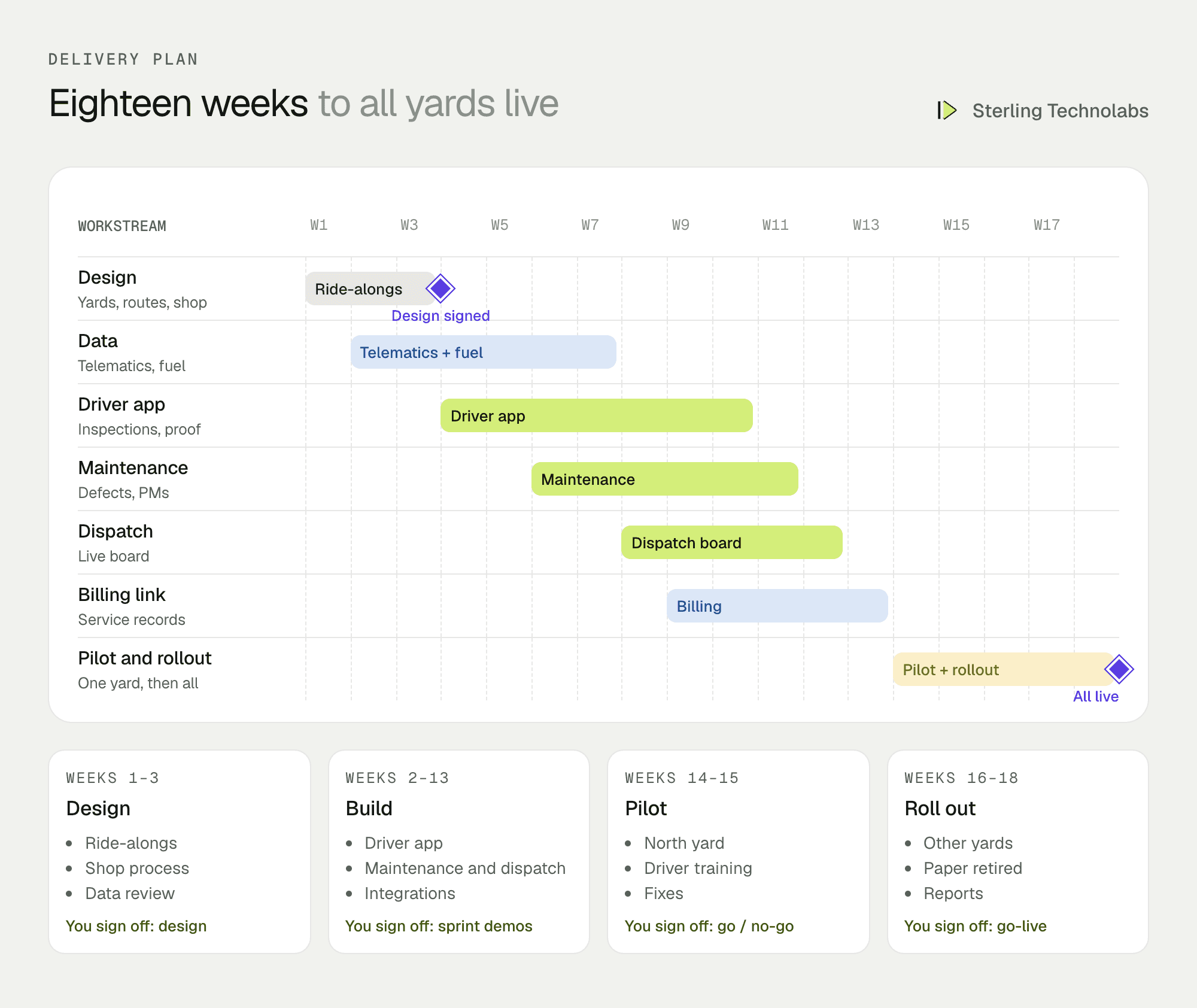
We'd start with ride-alongs on each route type, then pilot at one yard with its drivers, dispatchers and shop. Paper inspections stop at that yard after the pilot, and the other yards follow one at a time.
The team
| Role | Time | What they own |
|---|---|---|
| Solution architect | Part time | Architecture, telematics and billing integrations |
| Product designer | Weeks 1–8 | Driver app for the cab, dispatch board |
| Mobile developer | Full time | Driver app on tablets, offline use |
| Full-stack developers (2) | Full time | Maintenance, dispatch, reports, integrations |
| QA engineer | From week 6 | Device tests, integration tests, pilot support |
From your side: an operations manager, a dispatcher, a shop lead, two drivers for testing, and your billing system administrator.
What changes the effort
- Telematics providers. One provider is simpler than a mixed fleet with several.
- Service confirmation. Arm sensors make it automatic; without them, drivers confirm by tap.
- Routing. Using your current route plans is quicker than building route optimisation.
- Billing system. A modern API is quicker than file imports.
- Shops and parts. Parts inventory and purchasing add a phase.
Risks and how we'd handle them
| Risk | What we'd do |
|---|---|
| Drivers find the app slow | Designed with drivers on ride-alongs, large buttons, inspections in under five minutes. |
| No signal on rural routes | The app works offline and syncs when signal returns. |
| Unsafe trucks leave the yard | Safety-critical defects block the route until the shop clears the truck. |
| Regulatory records lost | Inspections and repairs kept for the required retention period, with audit history. |
| Driver distraction | The app locks to essential actions when the truck is moving. |
What we'd measure
| Metric | How we'd measure it | Baseline from |
|---|---|---|
| Preventive maintenance on time | PMs done by their due point | Maintenance spreadsheet |
| Breakdowns on route | Road calls per month | Shop records |
| Defect to repair time | Hours from report to fix | Paper sheets |
| Missed pickup disputes | Credits given for disputed service | Billing system |
| Cost per truck | Parts, labour and fuel per truck | Accounting |
Build or buy?
Fleet maintenance software and hauler-specific route products exist, and for many fleets they are the sensible choice. Custom fleet management software development makes sense when you need to connect telematics, maintenance, driver workflows and billing in one system, when your operation has steps the products don't cover, or when per-truck fees add up across a large fleet. Many fleets keep their telematics and billing systems and build the layer that connects them.
Questions we'd ask on the first call
- How many trucks, yards and route types do you run?
- Which telematics, ELD and camera providers do you use?
- How do inspections and maintenance work today?
- How do you handle missed pickup disputes?
- Which billing system do you use?
FAQ
What does custom fleet management software include?
Usually a driver app for inspections and jobs, maintenance management, a dispatch board and reports, connected to your telematics, fuel cards and business systems.
Can it use our existing telematics?
Yes. Most telematics providers have APIs for location, engine data and fault codes, so you don't need new hardware.
Does it replace our ELD?
No. Hours of service stay in your certified ELD. The fleet system can show that data alongside everything else.
How long does fleet management software development take?
A first release with the driver app, maintenance, dispatch board and billing link typically takes 16 to 18 weeks.
:: Typical stack
Driver app on rugged tablets, React, Node.js, PostgreSQL, telematics APIs (Samsara, Geotab), fuel card feeds, billing system integration
:: Related service
Mobile app development
See the service

Send us your brief. We’ll help turn it into reality
A senior engineer replies within one business day with questions or a first plan: approach, team, timeline and estimate.
More blueprints like this


