Custom ERP for a made-to-order furniture manufacturer
Made-to-order furniture makers outgrow ERPs built for standard products. This is how we'd build custom ERP software where every configured order gets its own bill of materials, a place on the production schedule and a real ship date for the dealer.
Industry
Furniture manufacturing
Typical timeline
20–24 weeks
Typical team
7 people

The situation
Picture an upholstered furniture manufacturer in Hickory, North Carolina, with 260 employees and one plant. It makes sofas, sectionals, chairs and ottomans to order, about 300 pieces a week, and sells through 400 independent furniture retailers, its own two showrooms and its website. Almost nothing is built for stock: every piece has its own frame size, fabric, cushion fill, arm style and finish.
The business runs on an ERP that was set up 15 years ago for standard products. It can't handle configured items, so orders arrive by email or fax, and the customer service team keys them in. Bills of materials and fabric yardage are worked out by hand from spreadsheets. The production schedule is a whiteboard in the planner's office. Fabric shortages are found when the cutter goes to the roll. Dealers call every day to ask when orders will ship, and the answer is a guess.
The owners looked at mainstream ERPs and furniture-specific packages. The ones that handled their configuration rules needed heavy customisation anyway. They want custom ERP software built around made-to-order furniture, connected to the accounting system they already use.
Signs this blueprint fits you
- You make products to order with many options, and your ERP can't handle the combinations.
- Bills of materials and material quantities are worked out by hand.
- The production schedule lives on a whiteboard or spreadsheet.
- Material shortages are found on the shop floor.
- Dealers and customers call to ask when their order will ship.
What we'd build
- A product configurator with your option rules: which frames take which arms, fabric limits by style, yardage by size, and prices by dealer tier.
- A dealer portal where retailers configure and order, see prices and expected ship dates, track orders and download invoices.
- A bill of materials for every order, built from the configuration: frame parts, fabric yardage, foam and fill, hardware, cutting lists and standard cost.
- Production scheduling by work center (frame, cutting, sewing, upholstery, packing), with capacity, fabric availability and truck routes taken into account.
- A shop floor app on tablets at each station: today's work, cutting lists, scans when work starts and finishes, and quality check photos.
- Purchasing and inventory for fabric, foam, lumber and hardware, with reorder points and purchase orders to fabric mills and suppliers.
- Shipping and accounting: orders grouped into truck routes, freight for long-distance dealers, and invoices posted to accounting.
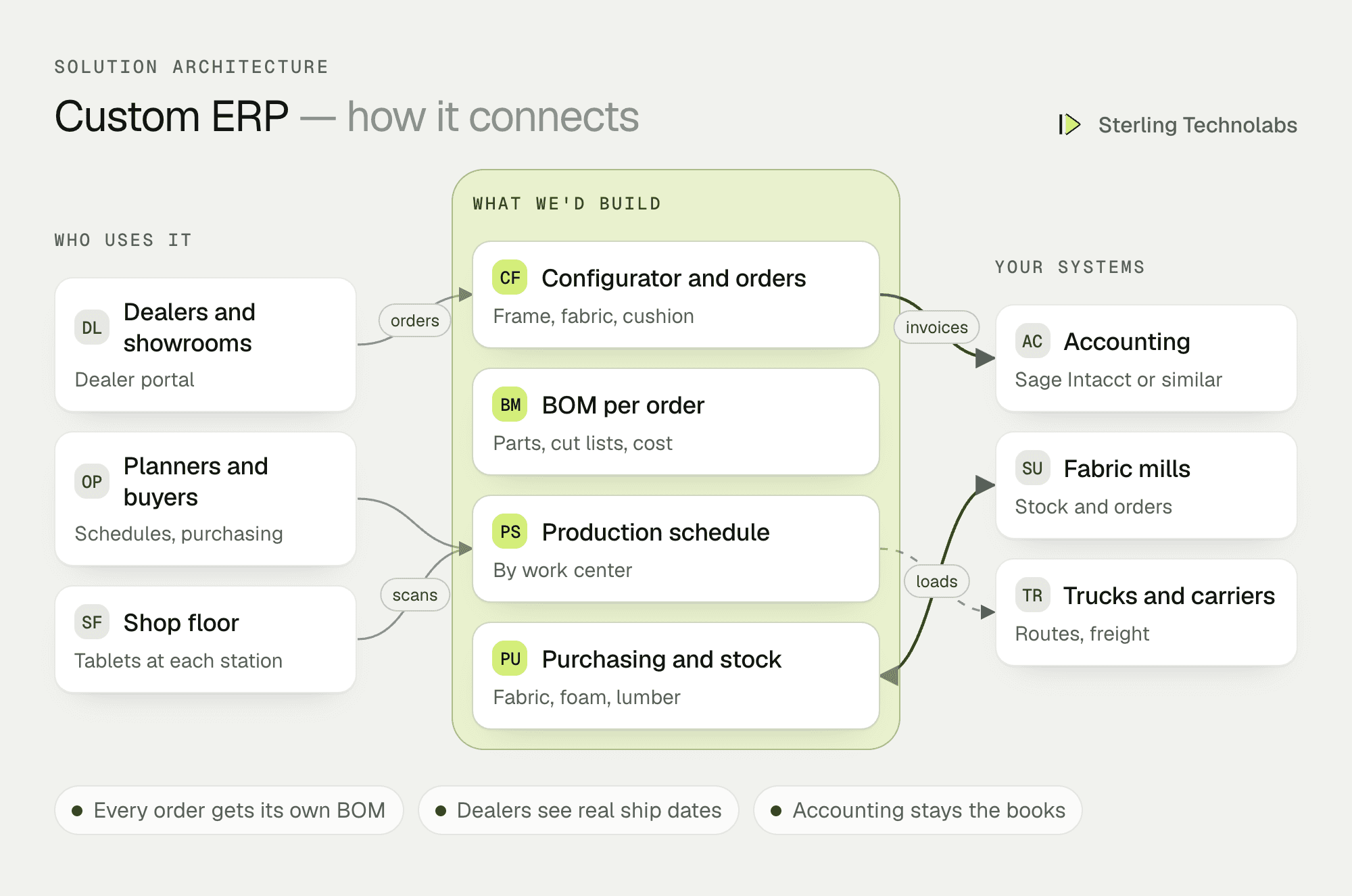
How the pieces fit
Configuration drives everything
The configurator is the heart of the system. Every rule your sales and engineering teams carry in their heads is written down once: allowed combinations, yardage by style and size, pattern matching for striped fabrics, and price by option. Once an order is configured, the ERP generates its bill of materials, cutting list, routing through the plant and cost. Nobody re-enters anything.
Scheduling that knows the plant
Each work center has a daily capacity. The schedule places orders by ship date and truck route, checks that fabric is in stock or arriving in time, and shows the load on each station. When sewing is overloaded, the planner sees it a week ahead and can move work or add a shift. Orders waiting on customer-supplied fabric stay off the floor until the fabric arrives and passes inspection.
The shop floor records the truth
Every order carries a barcode tag. Stations scan it when work starts and finishes, so the system knows where each piece is without anyone walking the floor. That data feeds real ship dates to dealers, and over time shows actual labour time by model, which makes standard costs accurate.
Accounting stays the books
Your accounting system, such as Sage Intacct, QuickBooks or NetSuite, stays the record for the general ledger, receivables and payables. The ERP posts invoices, receipts and inventory values daily. Custom ERP development doesn't mean rebuilding accounting, which is well served by the products you already have.
One custom sofa, end to end
Here is a three-seat sofa ordered by a dealer in customer's own fabric.
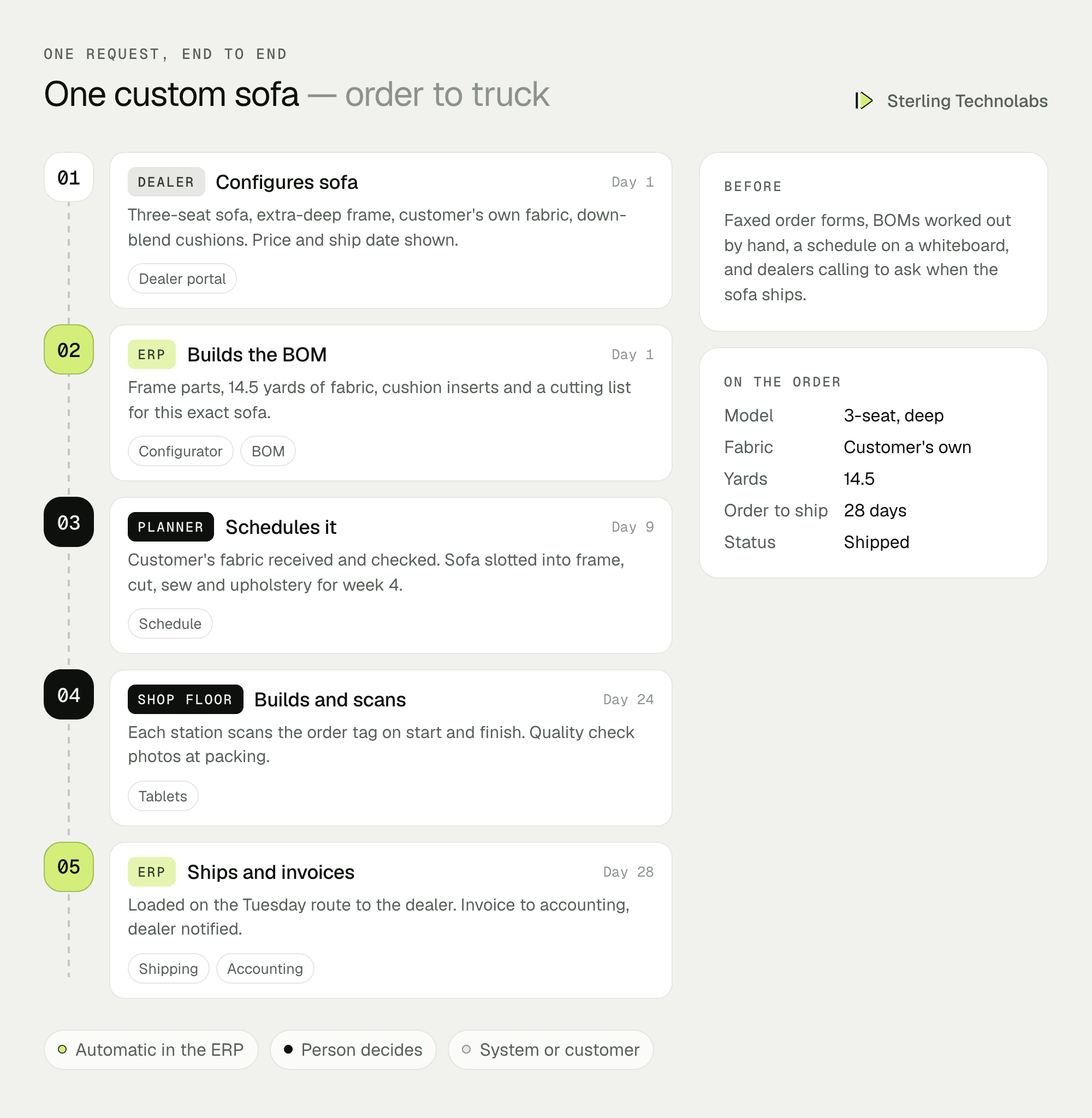
The dealer saw a ship date when ordering, and the order moved from portal to truck without being re-typed once.
What planners would see
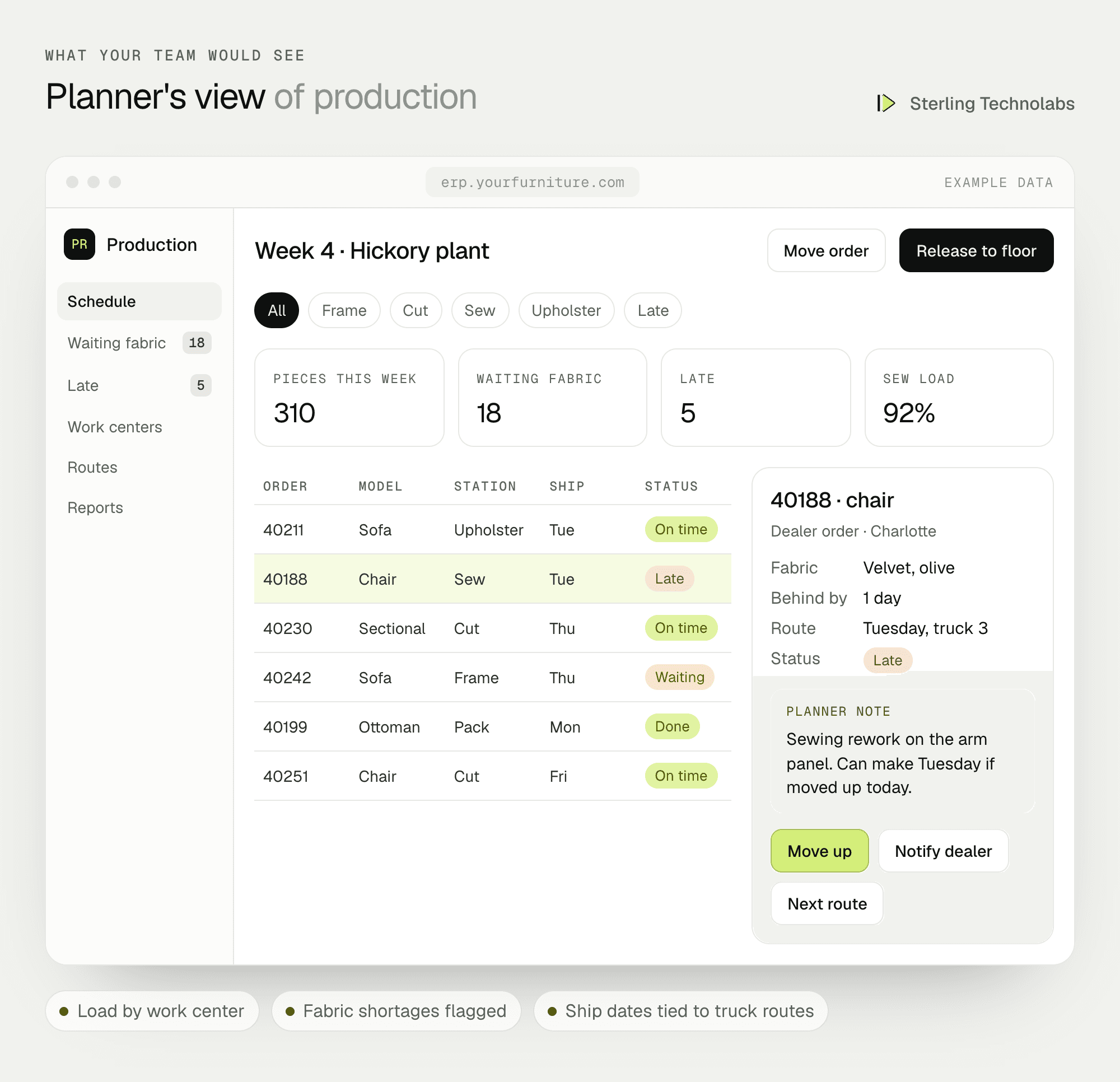
Planners see the week's orders by work center, with late orders and fabric shortages at the top. Customer service sees the same order status the dealer sees in the portal.
Custom ERP features by team
| Sales and dealers | Planning and purchasing | Shop floor and shipping |
|---|---|---|
| Configurator with option rules | Schedule by work center | Tablets at each station |
| Dealer portal and order tracking | Fabric and material checks | Cutting lists per order |
| Prices by dealer tier | Purchase orders to mills | Start and finish scans |
| Ship dates when ordering | Load and late-order reports | Truck routes and loading |
Data and integrations
| Data | System of record | Direction | When |
|---|---|---|---|
| Products, options, rules, prices | Custom ERP | ERP only | Not applicable |
| Orders, BOMs, schedules, shop floor scans | Custom ERP | ERP only | Not applicable |
| Invoices, receipts, inventory value | Accounting system | ERP to accounting | Daily |
| Fabric stock and orders | Fabric mills | Both ways, where mills offer it | Daily |
| Freight quotes and tracking | Carriers | Both ways | When a load is booked |
| Website orders | Ecommerce store | To the ERP | As orders arrive |
Delivery plan
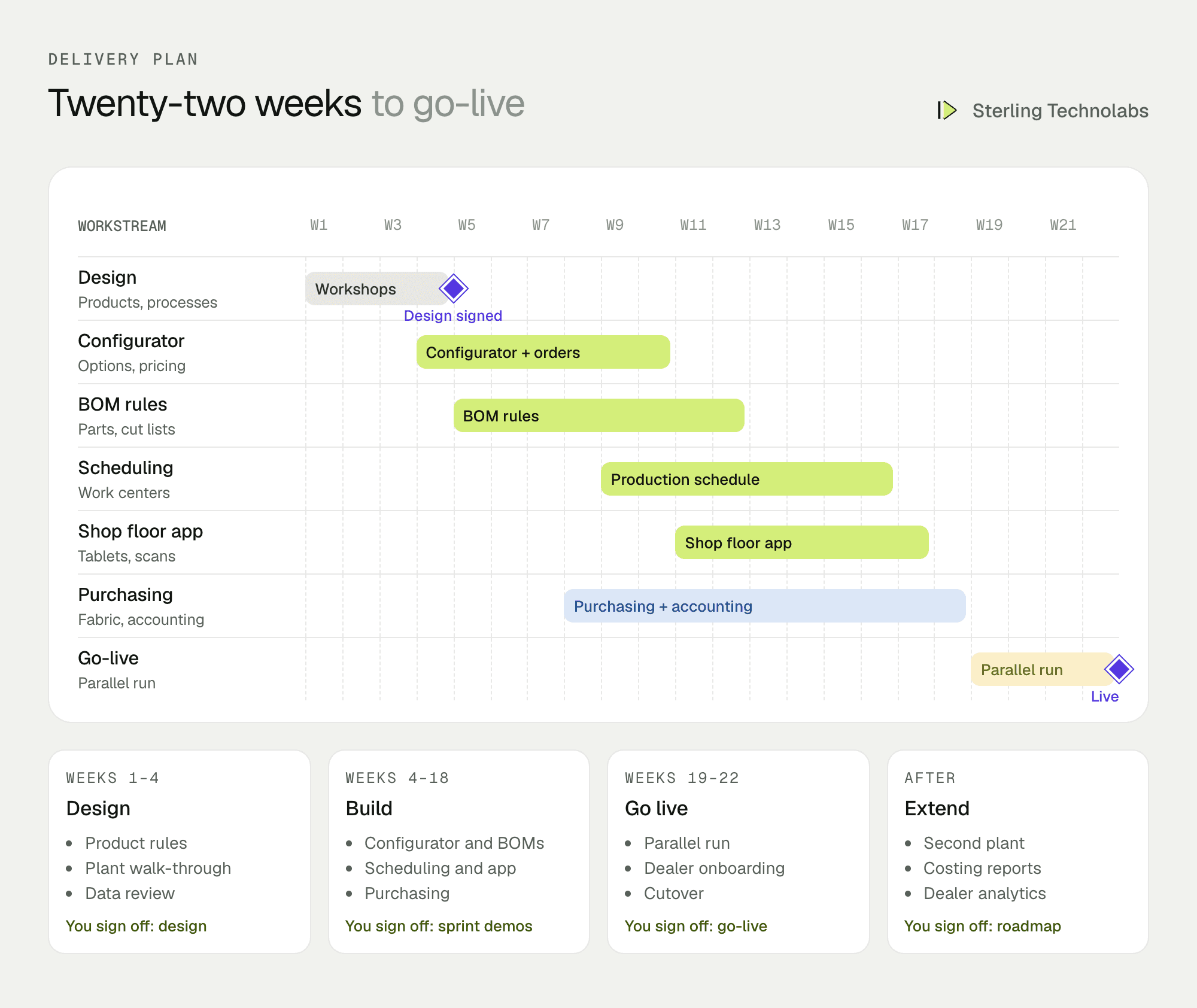
We'd run the new ERP alongside the old process for three weeks before cutover, comparing BOMs and schedules order by order. Dealers move to the portal in groups after go-live, starting with the largest accounts.
The team
| Role | Time | What they own |
|---|---|---|
| Solution architect | Part time | Architecture, data model, integrations |
| Business analyst with manufacturing experience | Full time | Product rules, plant processes, UAT |
| Product designer | Weeks 1–10 | Configurator, portal and shop floor screens |
| Back-end developers (2) | Full time | Configurator, BOMs, scheduling, integrations |
| Front-end developer | Full time | Dealer portal, planner screens, shop floor app |
| QA engineer | From week 8 | Rule tests, BOM checks, parallel run |
From your side: a plant manager, the production planner, a product engineer who knows the option rules, a customer service lead and your controller.
What changes the effort
- Product rules. The number of models and options, and how many exceptions exist, matters more than anything else.
- Plants. A second plant adds transfers and scheduling across sites.
- Costing. Standard costs are simpler; actual job costing by labour scan takes longer.
- Dealer integrations. Large retailers that send orders by EDI add work.
- Data. Clean product and fabric data shortens the build; spreadsheets with years of exceptions take time to sort out.
Risks and how we'd handle them
| Risk | What we'd do |
|---|---|
| Option rules incomplete | Rules tested against a year of past orders before go-live. |
| Wrong fabric yardage | BOMs compared with the cutters' actual usage during the parallel run. |
| Production disrupted at cutover | Three-week parallel run and cutover on a weekend with the floor cleared. |
| Shop floor staff skip scans | One scan per station, large buttons, and tablets mounted where work happens. |
| Dealers keep emailing orders | Portal onboarding by account, with customer service entering orders in the portal during the change. |
What we'd measure
| Metric | How we'd measure it | Baseline from |
|---|---|---|
| Order to ship time | Days from order to loaded truck | Current order records |
| On-time shipping | Orders shipped on the promised date | Current order records |
| Order entry time | Staff hours keying orders each week | Customer service team |
| Fabric waste | Yards used against yards planned | Cutting room records |
| Dealer status calls | Calls asking for ship dates | Phone system |
Build or buy?
For manufacturers with standard products, an established ERP is usually the right call, and we'd tell you so. Custom ERP software development makes sense when your products are configured to order, when the ERPs that handle configuration need so much customisation that you're paying for a custom build anyway, or when your process is what sets you apart. A common middle path is a custom ERP for orders, configuration and production, with an off-the-shelf accounting system behind it.
Questions we'd ask on the first call
- How many models and options do you offer, and how are the rules kept today?
- How many orders a week, through which channels?
- How is production scheduled now, and where are the bottlenecks?
- Which accounting system do you use, and will it stay?
- How do dealers order and find out ship dates today?
FAQ
What is custom ERP development?
Building ERP software around your own products and processes, such as made-to-order manufacturing, instead of adapting them to a standard product. It usually covers orders, production, purchasing and inventory, and connects to accounting.
Is there ERP software for furniture manufacturing?
Yes, several products serve furniture makers. They suit many companies. Custom makes sense when your configuration rules, dealer process or plant don't fit them.
How much does custom ERP software development cost?
It depends mostly on product rules, plants and integrations. We give a written estimate after the first call, with a phased plan so the first release is useful on its own.
How long does it take to build a custom ERP?
For one plant, with the configurator, dealer portal, production scheduling, shop floor app and purchasing, typically 20 to 24 weeks.
:: Typical stack
React, Node.js, PostgreSQL, shop floor tablets, barcode scanning, dealer portal, Sage Intacct or QuickBooks, carrier APIs
:: Related service
Custom software development
See the service

Send us your brief. We’ll help turn it into reality
A senior engineer replies within one business day with questions or a first plan: approach, team, timeline and estimate.
More blueprints like this


