AI resume screening for a healthcare staffing agency
Recruiters lose good candidates while they read resumes one by one. This is how we'd build AI resume screening for a staffing agency: every resume parsed, checked against each job's real requirements and ranked with evidence, with recruiters making every decision.
Industry
Healthcare staffing
Typical timeline
10–12 weeks
Typical team
4 people

The situation
Picture a healthcare staffing agency placing travel and per diem nurses, respiratory therapists and techs across 30 states. It receives around 4,000 applications a week through its website, job boards and referrals, and runs everything in Bullhorn.
Recruiters spend most of their morning opening resumes one by one. Is this nurse licensed in the right state? Do they have two years of ICU experience? Is their BLS current? Strong candidates sit unread for days while recruiters work the newest applications, and a competitor calls them first. Resume data in the ATS is incomplete because nobody has time to type it in, so searching the existing database misses people who would be a good fit for today's job.
The agency wants AI resume screening that does the reading: extract the facts from every resume, check them against each job's real requirements, and give recruiters a ranked shortlist with reasons, while recruiters keep every hiring decision.
Signs this blueprint fits you
- Recruiters spend hours a day reading resumes before they talk to anyone.
- Good candidates wait days for a first response.
- Your ATS has thousands of past applicants you can't search effectively.
- Job requirements are specific and checkable: licences, certifications, years in a setting, shifts.
- You want screening that can be explained and audited, not a black-box score.
What we'd build
- Resume parsing for every new application and the existing database: contact details, licences and states, certifications with expiry dates, employers, settings, specialties and dates.
- Requirement matching against each job order's must-haves and nice-to-haves, set by recruiters in plain language and stored as structured criteria.
- A ranked shortlist per job, showing which requirements each candidate meets, which are missing and which need checking, with the evidence quoted from the resume.
- Database rediscovery: past applicants who match a new job surface automatically, so the agency recruits from its own talent pool first.
- Candidate follow-up: a short text or email asking for missing details, such as a licence number or availability date.
- Fairness monitoring with selection-rate reports by group, using voluntary self-identification data kept separate from screening.
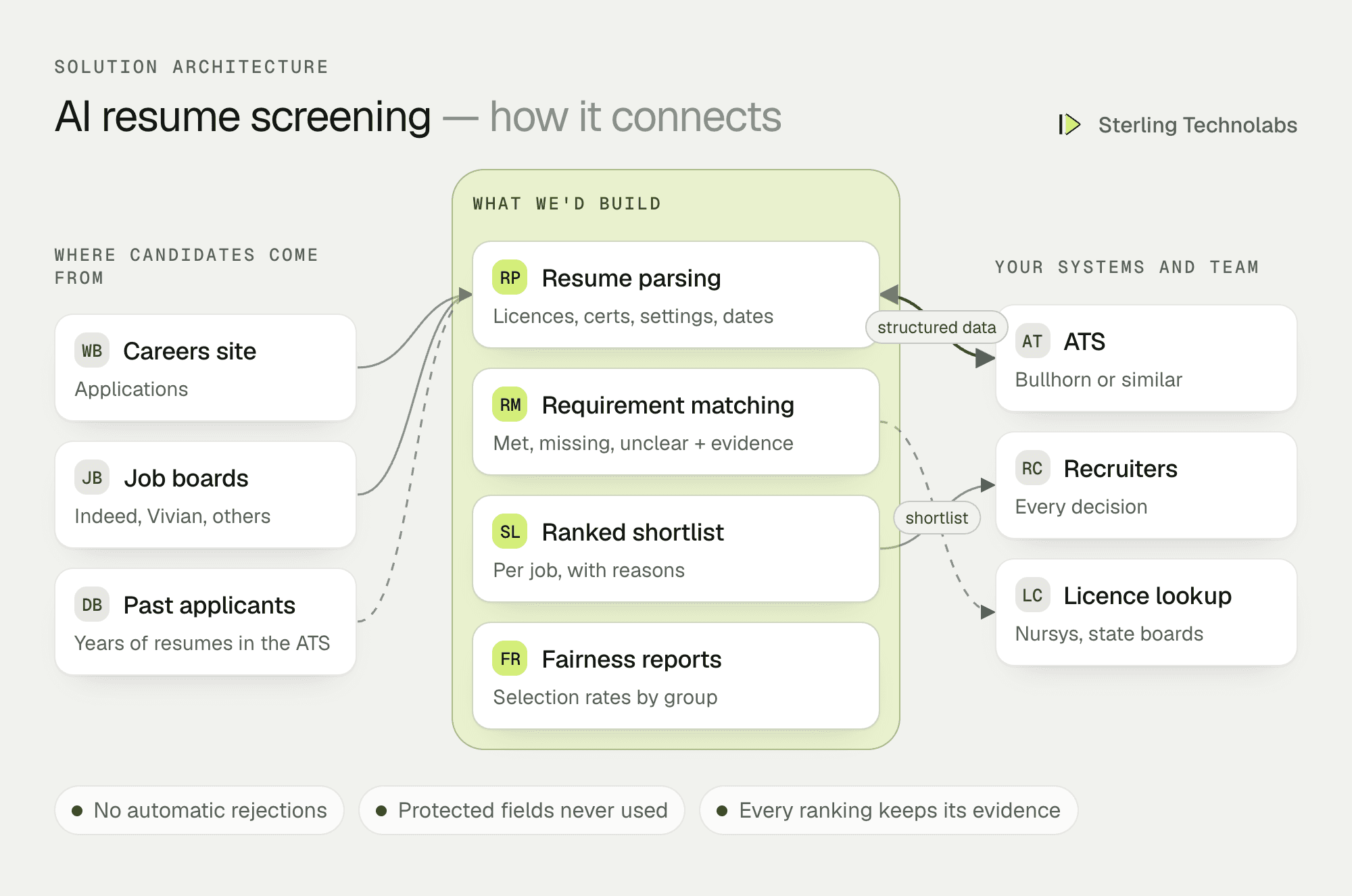
How the pieces fit
The ATS stays the record
Candidates, jobs and placements stay in Bullhorn (or another ATS such as Greenhouse, Lever or JobDiva). New applications are picked up through its API, parsed, and the structured data is written back to the candidate record, so recruiters search better data even when they don't use the shortlist.
Matching on requirements, not on keywords
Each job order is turned into a short checklist: state licence, years in ICU, BLS and ACLS current, shift preference, start date. A language model reads the resume and records, for each item, met, not met or unclear, with the sentence it relied on. Candidates are ranked by must-haves first, then nice-to-haves. Recruiters can see and change the checklist for every job.
What screening never uses
The system does not use names, photos, addresses beyond the state needed for licensing, age, graduation years, gaps in employment or any protected characteristic. Those fields are removed before matching. The model never rejects anyone; it orders the queue and explains the order.
Compliance and audit
Every ranking stores the checklist version, the evidence and the outcome. Selection rates are reported by group so adverse impact can be spotted early. If you hire in New York City or other places that regulate automated employment decision tools, the design supports the required bias audits and candidate notices. Your employment counsel sets the policy; the software makes it checkable.
One application, end to end
Here is an ICU nurse applying for a 13-week contract in Phoenix.
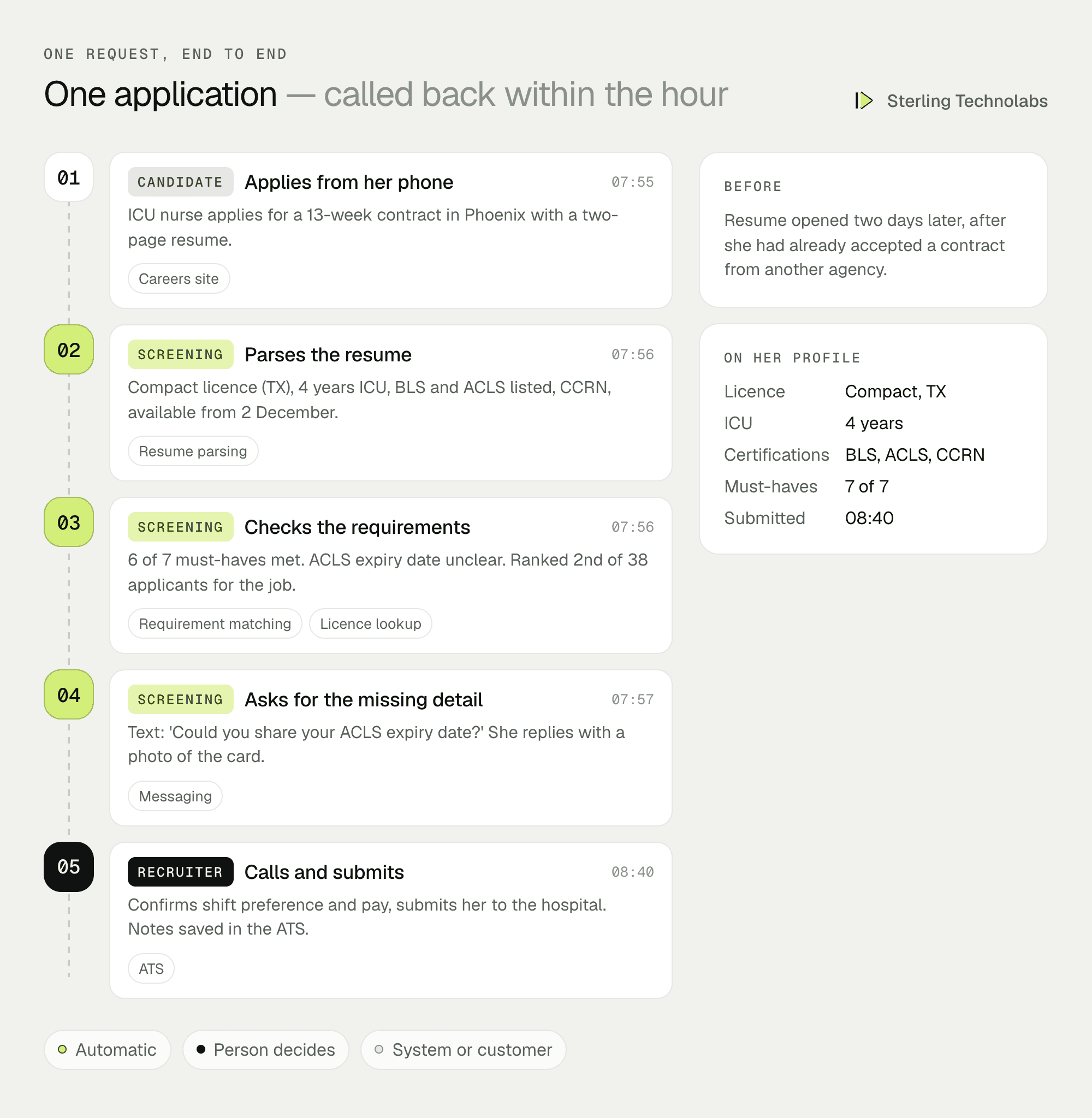
The recruiter's first contact happened within an hour of the application, with the facts already checked and one open question to ask. The decision to submit the candidate to the hospital was still the recruiter's.
What recruiters would see
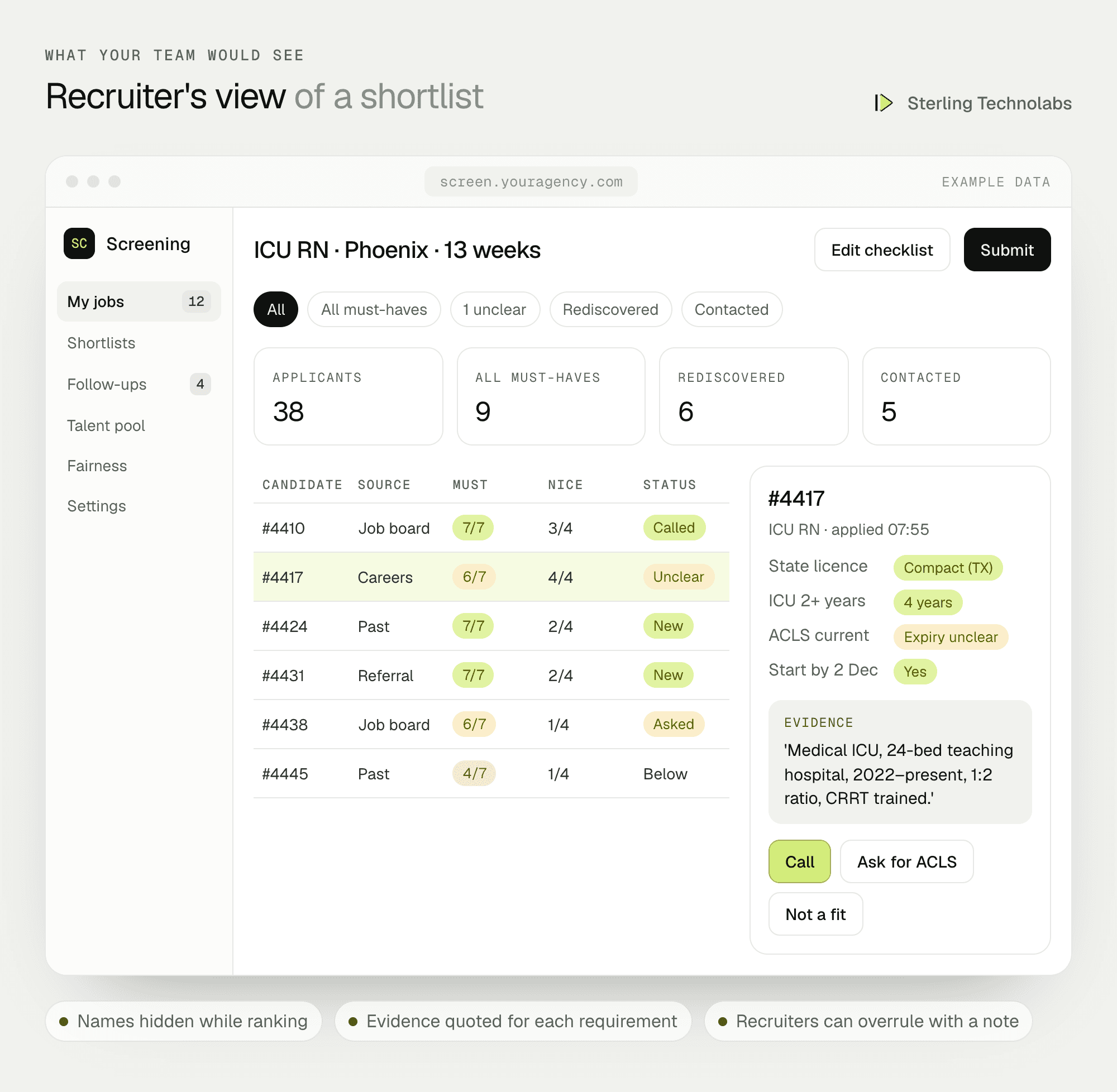
Recruiters open a job and see candidates in order, each with requirements met and missing. Clicking a candidate shows the evidence from the resume next to each requirement, so they can confirm in seconds or overrule with a note.
Automated resume screening: what's automated and what isn't
| Step | Automated | Done by a recruiter |
|---|---|---|
| Reading resumes | Parsing and requirement checks | Spot checks and corrections |
| Ordering the queue | Ranking with reasons | Changing requirements |
| Missing information | Text or email to the candidate | Follow-up calls |
| Decisions | Nothing | Every reject, submit and offer |
| Fairness | Selection-rate reports | Review and action |
Data and integrations
| Integration | What it's for | Example options |
|---|---|---|
| ATS | Candidates, jobs, notes, status | Bullhorn, Greenhouse, Lever |
| Job boards | Incoming applications | Through the ATS or directly |
| Licence lookups | Verify nursing licences | Nursys or state boards |
| Messaging | Candidate follow-up | SMS and email provider |
| Language model | Reading resumes against requirements | Enterprise API with no training on your data |
Delivery plan
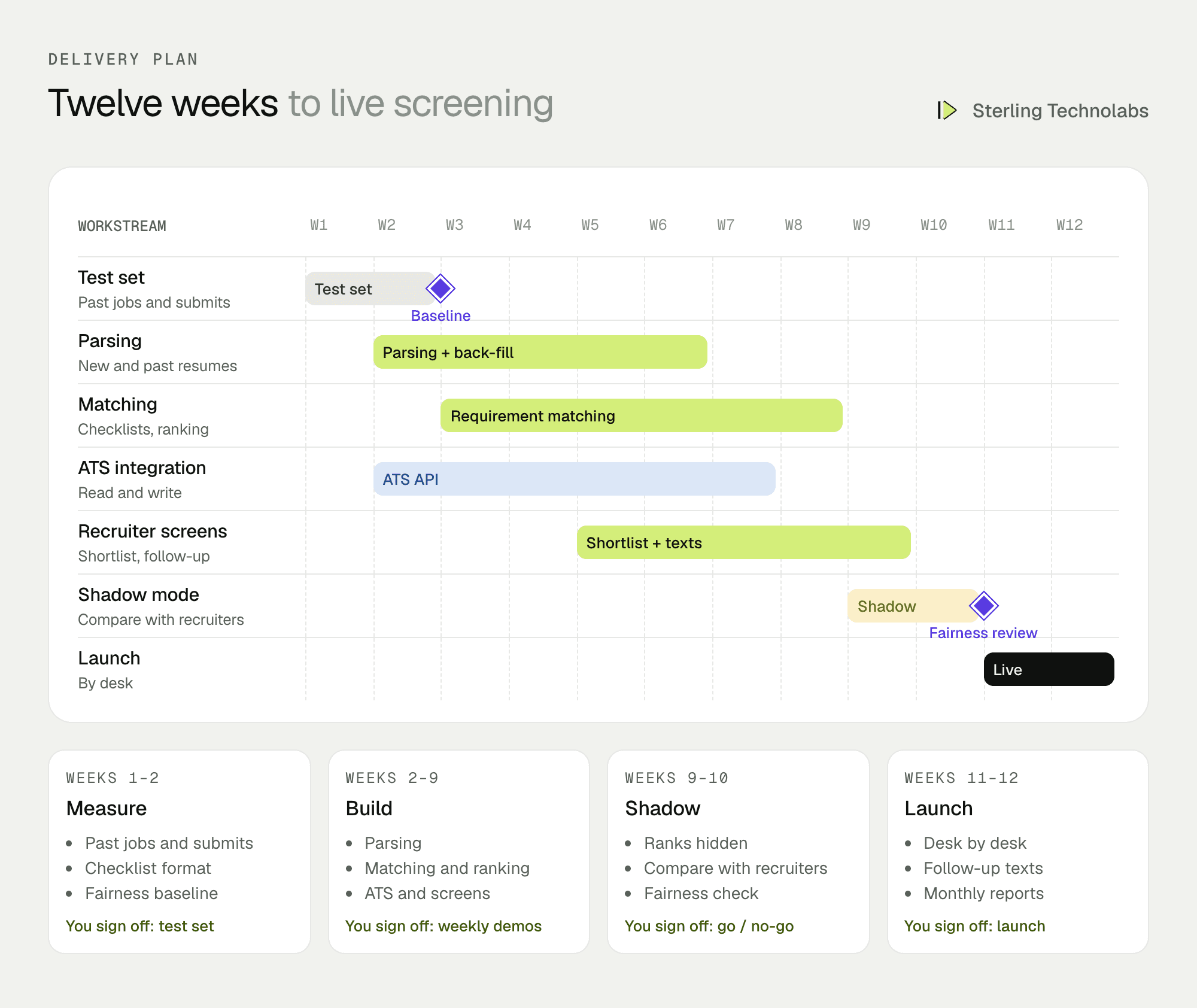
We start by measuring: a sample of past job orders and the candidates recruiters actually submitted becomes the test set for parsing and matching. Screening then runs in shadow mode, ranking candidates without anyone seeing the result, so we can compare it with recruiters' choices before switching it on.
The team
| Role | Time | What they own |
|---|---|---|
| Solution architect | Part time | ATS integration, data protection, model choice |
| ML engineer | Full time | Parsing, requirement matching, evaluation |
| Full-stack developer | Full time | Shortlist screens, job checklists, follow-up |
| QA and data analyst | From week 4 | Test sets, accuracy and fairness reports |
From your side: two or three senior recruiters, your ATS administrator and your employment counsel.
What changes the effort
- Roles. Healthcare roles with licences are easier to check than roles judged on soft skills.
- ATS. A well-documented API is quicker than file exports.
- Database size. Re-parsing hundreds of thousands of past resumes is a one-off job that needs planning.
- Jurisdictions. Hiring in places with automated decision rules adds audit and notice work.
- Languages. Resumes in several languages add testing.
Risks and how we'd handle them
| Risk | What we'd do |
|---|---|
| Biased outcomes | Protected and proxy fields removed, ranking on stated requirements only, selection rates monitored and reviewed monthly. |
| Wrong extraction | Evidence shown for every requirement, recruiters correct it, accuracy tracked by field. |
| Over-reliance | No automatic rejections; every candidate stays visible and searchable. |
| Candidate data misuse | Enterprise model endpoints with no training on your data, encryption, retention rules. |
| Regulation changes | Checklist versions and logs make audits and notices straightforward to add. |
What we'd measure
| Metric | How we'd measure it | Baseline from |
|---|---|---|
| Time to first contact | Application to first recruiter call or message | ATS activity log |
| Recruiter screening time | Hours a week spent reading resumes | Time study |
| Submit-to-interview rate | Submitted candidates who get an interview | ATS reports |
| Rediscovered placements | Placements from past applicants | ATS source data |
| Selection-rate ratios | Shortlist rates by group | New, from self-ID data |
Build or buy?
Many ATS products now include AI screening, and some standalone tools do it well. A custom build makes sense when your requirements are specific and checkable (licences, certifications, settings), when you want the reasons and the audit trail under your control, when per-seat or per-candidate pricing is expensive at your volume, or when you want screening tuned on your own placement history.
Questions we'd ask on the first call
- How many applications a week, for which roles?
- Which ATS do you use, and how complete is its candidate data?
- What do recruiters check first when they open a resume?
- Where do you hire, and which automated hiring rules apply?
- Can we use past job orders and submissions to test the matching?
FAQ
What is AI resume screening?
It is software that reads resumes, checks them against a job's requirements and orders candidates for a recruiter, showing the evidence for each decision it suggests.
Does AI resume screening reject candidates?
Not in this design. It ranks and explains; recruiters make every reject and submit decision.
How do you prevent bias?
By screening only on job requirements, removing protected and proxy fields, keeping evidence for every ranking and monitoring selection rates by group.
What is resume parsing software?
Software that turns a resume into structured data: contact details, work history, skills, licences and dates. It's the first step of screening and also makes your ATS easier to search.
:: Typical stack
Resume parsing, language model via enterprise API, Python, Bullhorn API, licence lookup, React, AWS
:: Related service
Machine learning development
See the service

Send us your brief. We’ll help turn it into reality
A senior engineer replies within one business day with questions or a first plan: approach, team, timeline and estimate.
More blueprints like this


