Unlocking Salesforce Potential: How to Hire Dedicated Salesforce Developers?
Priyanka Shirapure
·

Salesforce can be configured a long way with clicks, but most companies reach a point where they need a developer: to build custom logic, connect Salesforce to other systems or fix an org that has grown messy over the years. Hiring the right person is harder than it looks, because "Salesforce developer" covers a wide range of skills. This guide explains what Salesforce developers do, which skills matter now, and how to hire one, whether in-house, freelance or as a dedicated developer through a partner.
What is Salesforce development?
Salesforce development means designing, building and extending applications on the Salesforce platform to fit how a business works. It goes beyond the configuration an admin does and usually includes code, integrations and more complex automation.
What Salesforce developers work on
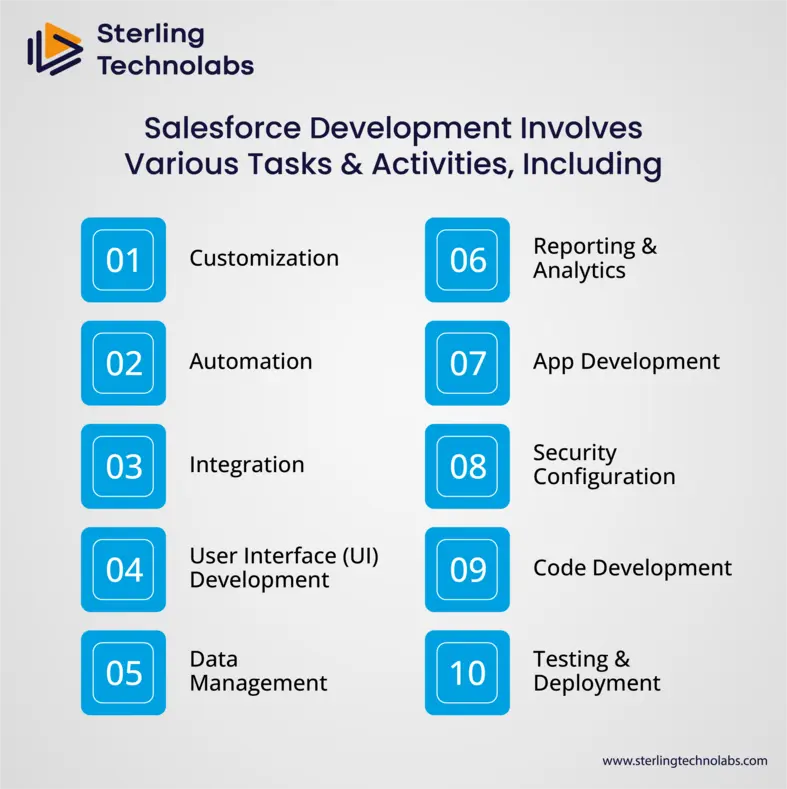
1. Customisation
Custom objects, fields, page layouts and record types that match your data and processes.
2. Automation
Flows for most automation, and Apex triggers and classes where Flow isn't enough. Salesforce ended support for Workflow Rules and Process Builder at the end of 2025, so a good developer should also be able to migrate older automation to Flow.
3. Integration
Connecting Salesforce to ERPs, billing systems, websites and data warehouses using REST and SOAP APIs, Platform Events, Change Data Capture or middleware such as MuleSoft.
4. User interface
Building screens and components with Lightning Web Components (LWC), the current standard. Older orgs may still have Visualforce pages and Aura components that need maintaining or replacing.
5. Data management
Data imports, migrations, deduplication and data quality, using tools such as Data Loader or custom scripts.
6. Reporting
Reports and dashboards, and sometimes CRM Analytics, so teams can track the numbers they care about.
7. Security
Profiles, permission sets, sharing rules and field-level security, so people see only the data they should.
8. AI and Agentforce
More and more projects involve Salesforce's AI features, including Agentforce agents and the data foundations they depend on. Developers increasingly need to know how to give these agents the right data, actions and guardrails.
9. Testing and deployment
Apex test classes (Salesforce requires at least 75% code coverage to deploy Apex to production), sandboxes, and source-driven deployment with Salesforce CLI, Git and tools such as DevOps Center.
Why hire a Salesforce developer?
Salesforce is only as useful as its fit to your business. A skilled developer can automate manual work, connect Salesforce to the rest of your systems, clean up technical debt and build features your teams actually use. A poor hire can leave you with fragile code, slow pages and automation nobody understands.
Skills to look for
Apex and SOQL, including writing bulk-safe code that stays within Salesforce's governor limits
Lightning Web Components and modern JavaScript
Flow, and good judgement about when to use Flow and when to use code
Integration experience with APIs, authentication and error handling
Data modelling and the Salesforce sharing and security model
Testing and DevOps: meaningful test classes, version control and deployment pipelines
Communication: explaining trade-offs to admins and business users
How to hire Salesforce developers: step by step
1. Define what you need
Write down the work: a one-off integration, a new app, ongoing enhancements or rescuing a troubled org. List the clouds you use (Sales Cloud, Service Cloud, Experience Cloud and so on). This decides whether you need a developer, an admin, an architect or a mix.
2. Choose a hiring model
In-house: best for long-term, continuous work, but slow and expensive to recruit for.
Freelancer: flexible for small, well-defined tasks, but harder to cover for holidays and turnover.
Dedicated developer through a partner: a developer who works only on your org, with the partner handling hiring, backup and quality. A good middle ground for ongoing work. See our hire Salesforce developers page for how this works with us.
Project-based consulting: a team that delivers a defined project, such as an implementation or an integration, for a fixed scope.
3. Check certifications, but don't stop there
Salesforce certifications such as Platform Developer, JavaScript Developer and the architect credentials show that someone has studied the platform. You can verify any certification on Salesforce's Trailhead credential verification site. But certifications don't prove someone can design a clean solution under real constraints.
4. Look at real experience
Ask candidates to walk you through projects similar to yours: what they built, what went wrong and what they would do differently. Ask about orgs with large data volumes or complex sharing if that applies to you.
5. Run a practical test
A short paid task or a code review exercise tells you more than a quiz. Look for bulk-safe Apex, sensible test classes, clear naming and an explanation of why they chose code or Flow.
6. Check communication and fit
Your developer will work with admins, business users and possibly other vendors. They need to explain technical choices in plain language and push back when a request will cause problems later.
7. Start with a trial period
Start with a defined piece of work or a trial period before committing long-term. It shows how the developer works in your org and with your team.
How much does it cost to hire a Salesforce developer?
Cost depends on location, seniority, certifications and hiring model. In-house salaries vary widely by country. Offshore dedicated developers usually cost less than local hires with similar experience. Whatever the rate, the cost of poor code, such as rework, failed deployments and lost adoption, is usually higher than the difference between a good developer and a cheap one.
Are Salesforce developers still in demand?
Yes. Salesforce remains one of the most widely used CRM platforms, and its push into AI with Agentforce and Data Cloud has created new work on top of the steady demand for integrations, migrations and maintenance. Developers who combine core Apex and LWC skills with Flow, integration and AI experience are the hardest to find.
Conclusion
To hire well, be clear about the work, pick the right hiring model, verify certifications, test real skills and start small. A dedicated developer from an experienced partner can give you senior skills without the time and risk of recruiting in-house.
Sterling Technolabs provides certified, dedicated Salesforce developers for ongoing work, and our Salesforce development services team handles defined projects. You might also like our post on why companies use Salesforce professional services.

Send us your brief. We’ll help turn it into reality
A senior engineer replies within one business day with questions or a first plan: approach, team, timeline and estimate.
:: Keep reading


